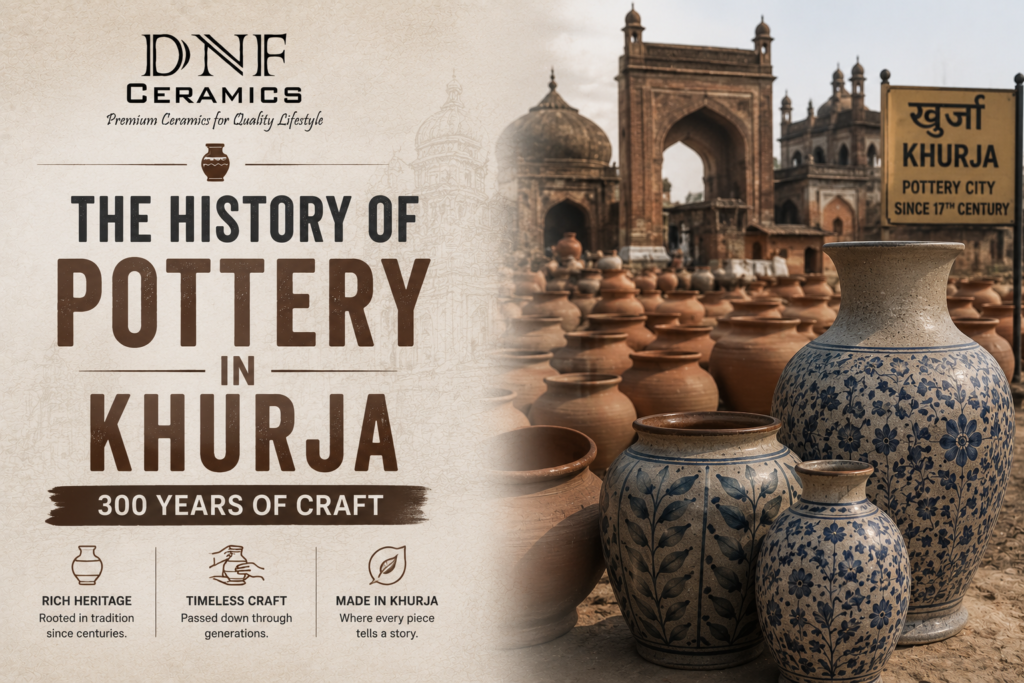
Three hundred years of continuous craft production is not a marketing claim — it is a historical fact about Khurja, and one that no other ceramic production centre in India can match. From the Mughal courts of the 17th century through the colonial transformation of the 19th, the industrial expansion of the 20th, and the design-led resurgence of the 21st, Khurja’s pottery tradition has adapted, absorbed new influences, and emerged stronger at each turning point. This is the story of that tradition — and of why it still matters for every buyer who chooses ceramics made here.
Before the Mughals: Ancient Roots
The precise origins of pottery making in the Khurja region are difficult to date with certainty. Archaeological evidence from the broader Gangetic plain suggests ceramic production in this region during the early historical period — functional earthenware for storage, cooking, and trade. The region’s clay geology — fine, workable deposits suited to both hand-forming and wheel-throwing — made it a natural location for craft production to develop and persist.
What distinguishes Khurja from other clay-rich regions of northern India is not simply the presence of suitable clay, but the concentration of craft knowledge, kinship networks of artisans, and trade infrastructure that accumulated over centuries to create a self-reinforcing cluster. Once established, such clusters tend to persist and intensify — each generation of artisans training in a richer environment of accumulated knowledge than the one before.
The Mughal Period: Persian Influences and the Blue Pottery Tradition
The most visible historical layer of Khurja’s ceramic heritage is the blue-and-white glazed pottery tradition associated with the Mughal period. The Mughal court, with its deep connections to Persian cultural traditions via the Central Asian heartland, brought a strong aesthetic preference for turquoise and cobalt-blue glazed pottery — a style refined over centuries in Persia, Samarkand, and later the imperial workshops of Delhi and Agra.
Khurja’s artisans absorbed this tradition and adapted it to local materials and tastes. The characteristic Khurja blue pottery — white or cream clay body, cobalt blue decorative painting, clear or blue-tinted glaze — became one of the most recognised craft traditions in northern India. It is still produced in Khurja today, alongside the full range of contemporary ceramic production. The blue pottery tradition is both a living craft and a historical record of the cultural exchanges that shaped Indian artistic life over four centuries.
The Colonial Period: Industrial Transformation
The 19th century brought significant change to Khurja’s ceramic tradition. British colonial administrators, initially focused on revenue and administration, eventually became interested in India’s craft industries as both a source of export commodities and as objects of documentation in the colonial project of cataloguing Indian culture. The Khurja ceramic tradition appeared in colonial craft surveys and exhibitions, giving it a degree of formal recognition that reinforced its identity as a distinct regional tradition.
More practically, the colonial period introduced industrial ceramic technologies to India — improved kiln designs, mechanical clay processing, and knowledge of European ceramic chemistry, particularly glaze formulation. Khurja’s artisans were among the earliest in India to adopt these technologies selectively, combining them with traditional craft approaches to produce a hybrid production model that could meet both traditional demand and new industrial-scale requirements. This early adoption of improved technology is one of the factors that gave Khurja its competitive advantage in the post-independence manufacturing expansion.
Post-Independence: The Making of a Manufacturing Capital
After 1947, the Indian government actively promoted small-scale industrial clusters as part of the broader industrialisation strategy. Khurja received investment in infrastructure — improved roads, electricity supply, government support for small-scale ceramic units — that catalysed rapid growth. The number of ceramic manufacturing units in Khurja expanded dramatically through the 1950s, 1960s, and 1970s.
DNF Ceramics was established in 1976 — at the height of this expansion period, when Khurja was consolidating its position as the dominant ceramic manufacturing hub in India. The cluster’s post-independence growth was driven by: growing domestic demand for tableware and decorative ceramics from a rapidly urbanising population; early export opportunities to the Gulf and UK markets; and the cluster dynamics that made Khurja increasingly attractive to new investment as each additional manufacturer reinforced the shared infrastructure and knowledge base.
The Contemporary Khurja: Tradition and Innovation
Today’s Khurja ceramic cluster combines the deep craft heritage of three centuries with the technical sophistication of modern ceramic manufacturing. High-temperature kiln firing using modern kiln technology, lead-free glaze chemistry meeting international safety standards, and precision clay body formulation coexist with wheel-throwing and hand-building techniques that have changed little in their essentials for hundreds of years.
The handmade vs machine-made question is particularly relevant in Khurja’s context. The cluster’s competitive strength lies precisely in the human skill embedded in its artisan workforce — the ability to produce at scale while retaining the qualities of craft production that machine-only manufacturing cannot replicate. For the story of the people behind our production, read Artisan Stories — Meet the Potters Behind DNF Ceramics. For what makes Khurja ceramics technically distinct, see What Makes Khurja Ceramics Different from Other Indian Pottery.
Why History Matters to Buyers
The history of pottery in Khurja is not merely interesting — it is commercially relevant. A manufacturer with 50 years of production history in a cluster with 300 years of accumulated craft knowledge is a fundamentally different supplier to one operating from an isolated facility without that depth of expertise. The quality of Khurja ceramics is not accidental. It is the product of three centuries of craft development, industrial adaptation, and the transmission of hard-won technical knowledge across generations.
For designers looking to source ceramics direct from Khurja, or for international buyers looking at top ceramic manufacturers in India for export, this heritage context is the foundation of the value proposition.