India is one of the world’s most significant sources of handmade ceramic products — and Khurja is the epicentre of that production. International buyers from the UK, Europe, the United States, Australia, the Gulf countries, and South-East Asia have sourced ceramic pots, planters, vases, and home décor from Khurja manufacturers for decades. The combination of artisan quality, manufacturing scale, and competitive factory pricing makes Indian ceramics one of the most attractive import categories in global home décor.
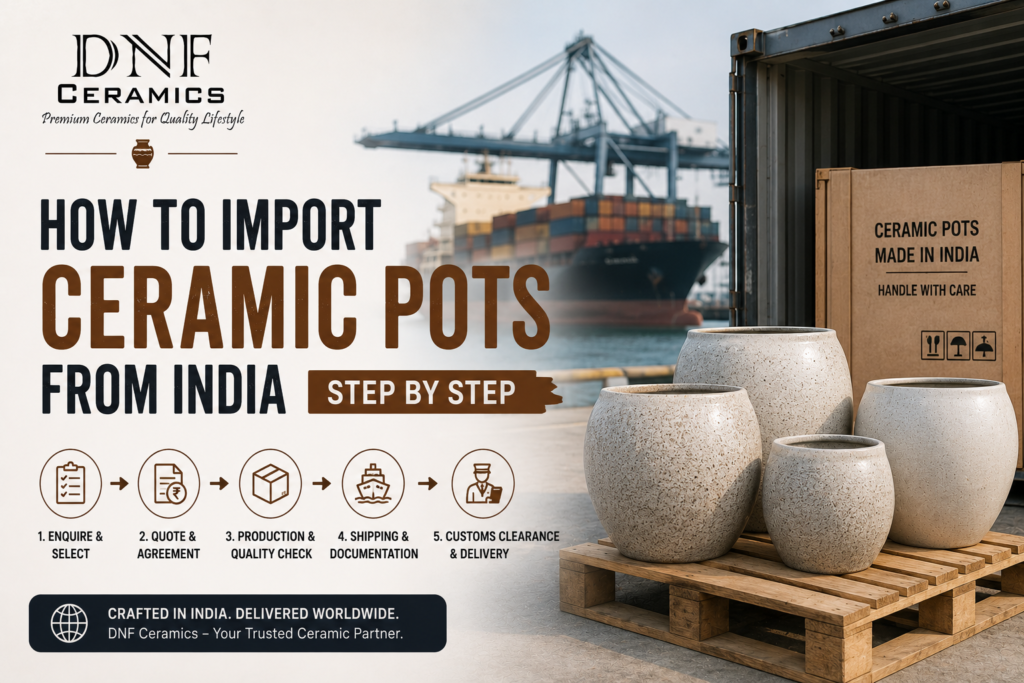
This guide is for international buyers who are either beginning their India sourcing journey or looking to move from sourcing through agents and intermediaries to a direct manufacturer relationship. It covers the full import process: supplier qualification, pricing terms, export documentation, shipping, customs, and what to expect at each stage.
Step 1: Qualify Your Supplier
Before placing any order, thoroughly qualify your manufacturer. For ceramic imports from India, verify: GST registration and export licence (IEC — Import Export Code); factory address and willingness to accept a factory visit or video inspection; product samples before bulk commitment; references from existing international buyers if available; and capacity to meet your volume requirements.
DNF Ceramics holds an active IEC, GST registration, and has been manufacturing and exporting from Khurja since 1976. We supply buyers in the UK, Europe, the UAE, and other international markets. For context on the Khurja manufacturing cluster and its international reputation, read Khurja: The Ceramic Capital of India. For a broader view of top-tier Indian ceramic exporters, see Top Ceramic Manufacturers in India for Export.
Step 2: Understand Pricing Terms
International ceramic orders are typically quoted on one of three pricing bases:
- Ex-Works (EXW): The manufacturer’s price at the factory gate. You arrange all freight, export customs clearance, and insurance from the factory. Lowest quoted price; highest buyer responsibility
- FOB (Free on Board): Price includes delivery to the port of export and loading onto the ship. The most common pricing basis for Indian ceramic exports — all costs up to the port are on the seller, all costs from the port are on the buyer
- CIF (Cost, Insurance, Freight): Price includes freight and insurance to the destination port. Simplest for the buyer; highest quoted price. Less common for ceramics
For most international buyers, FOB pricing from New Delhi ICD (for landlocked origin shipments) or Nhava Sheva (Mumbai) is the standard. Request FOB pricing in your initial quotation.
Step 3: Agree MOQ and Product Specification
International orders follow the same MOQ structure as domestic orders — 50 pieces per variant for most ceramic pots and planters, 25 pieces for FRP planters, 100 pieces for terracotta pots. For the full MOQ reference, read the MOQ guide.
For international buyers, shipping economics favour consolidating a larger order into a single container shipment. A 20-foot container holds approximately 1,500–2,000 medium-sized ceramic planters depending on size and packaging; a 40-foot container holds approximately double. If your order volume is below a full container, LCL (Less than Container Load) groupage is available — you pay for the cubic space your order occupies rather than a full container.
For custom ceramic specifications — bespoke glaze colours, non-standard sizes, or logo printing — allow additional time for the sample approval stage. Read the custom order guide for the full process.
Step 4: Export Documentation
For a ceramic import from India to any international destination, the standard export documentation package includes:
- Commercial Invoice — itemised list of all products, quantities, unit prices, and total FOB or CIF value. Used for customs valuation at destination
- Packing List — detailed list of all cartons, piece counts per carton, weights, and dimensions. Used by destination customs and your receiving warehouse
- Bill of Lading (sea freight) or Airway Bill (air freight) — issued by the shipping line, confirms shipment details and serves as the title document for your goods
- Certificate of Origin — confirms the goods originate in India. Required for preferential duty rates under trade agreements (e.g., India-UAE CEPA, India-ASEAN FTA)
- GST/Tax Invoice — required for Indian export formalities
- Lead-free glaze certificate — required for ceramic imports into the EU, UK, and US for any product that may contact food or beverages. DNF Ceramics provides written lead-free glaze certification for all export orders. For food-contact ceramic tableware, see our food-safe manufacturing standards
Step 5: HS Codes for Ceramic Imports
The most commonly applicable HS (Harmonised System) codes for Indian ceramic imports:
- 6913.10 — Porcelain or china decorative articles (vases, figurines)
- 6913.90 — Other ceramic decorative articles (non-porcelain/china)
- 6912.00 — Ceramic tableware, kitchenware, and household articles
- 6914.90 — Other ceramic articles
Verify the applicable code with your customs broker in the destination country — classification can vary by country and product type, and the correct code affects the duty rate applied.
Step 6: Shipping Lead Times for International Orders
Total lead time for an international ceramic order: production time (15–30 days depending on product and specification — see Lead Times for Bulk Ceramic Orders); export documentation preparation (3–5 days); sea freight from India to destination (18–25 days to UAE/Gulf; 20–28 days to Europe; 25–35 days to US East Coast; 28–35 days to Australia). Air freight is available for smaller urgent orders at significantly higher cost. Total order-to-warehouse timeline: 45–75 days depending on destination and production complexity. For first-time international orders, allow 90 days from initial enquiry to warehouse receipt.
Working with DNF Ceramics as an International Buyer
DNF Ceramics has experience working with international buyers across the full import process — from initial quotation and sample shipment through to full container export with complete documentation. Our export team handles: FOB pricing, packing list preparation, commercial invoice, certificate of origin, lead-free certification, and coordination with our freight forwarder for booking and documentation. For the retail buyer’s perspective on sourcing broadly, read our Wholesale Ceramic Pots: A Buyer’s Guide for Indian Retailers.