Commercial planter specification is a decision made at the intersection of aesthetics, performance, budget, and application context. The right material for a hotel lobby is not the right material for a resort poolside. The right material for a corporate campus exterior is not the right material for a boutique restaurant interior. Getting this decision right — and making it systematically rather than by intuition — produces commercial spaces where the planting feels integral rather than incidental. This guide covers the top 5 planter materials used in commercial projects in India, with an honest assessment of each.
Material 1: Glazed Ceramic — The Premium Indoor Standard
Glazed ceramic is the dominant material for premium commercial interiors — hotel lobbies, restaurant dining rooms, spa reception areas, corporate reception areas, and any guest or client-facing space where material quality is a brand statement. The case for ceramic is rooted in its physical properties: the weight, the surface depth, the tactile warmth, the durability of a high-fired glaze that does not yellow, chalk, or degrade under indoor conditions over decades.
The constraints: weight (significant for upper-floor and roof installations), price (higher unit cost than synthetic alternatives), and size range (very large formats above 120cm become structurally challenging in ceramic). For the full case for ceramic in hotel lobbies specifically, read Best Large Ceramic Planters for Hotel Lobbies India 2025. Browse the ceramic pots and planters range.
Best for: Hotel lobbies, restaurant interiors, boutique hotel public areas, corporate reception, luxury residential. For a more detailed comparison with FRP, see FRP vs Ceramic Planters — Which is Better for Hotels.
Material 2: FRP — The Large Format and Outdoor Champion
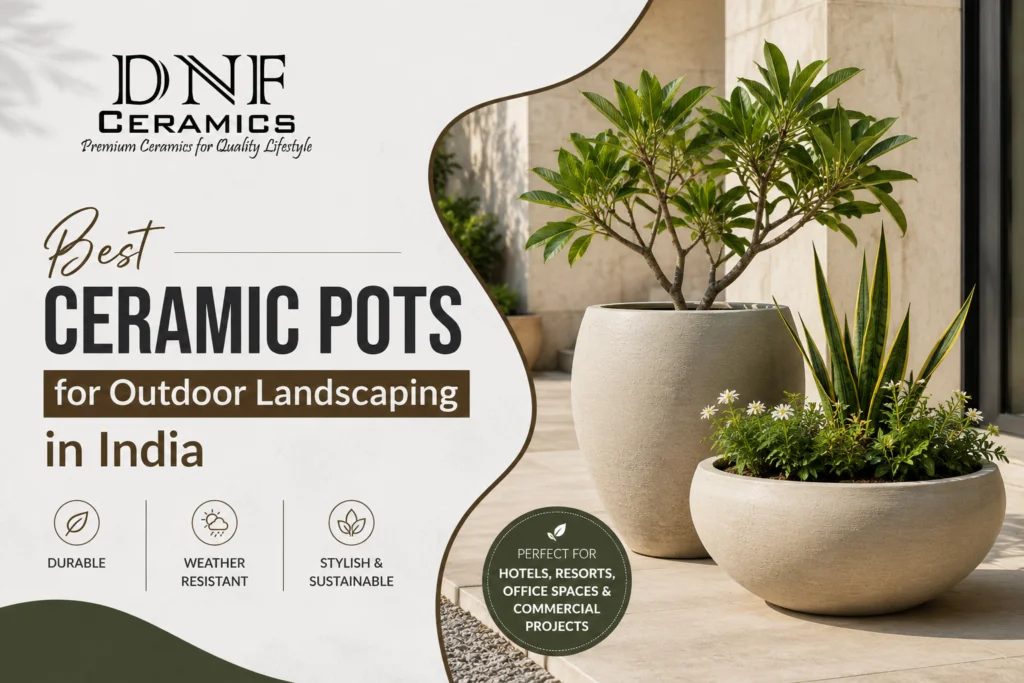
FRP (Fibre Reinforced Plastic) dominates commercial outdoor landscaping and large-format interior installations for one set of reasons: it can be produced in very large sizes at a fraction of the weight of ceramic, it is UV-stabilised for outdoor use, and it is significantly less expensive per unit than ceramic at large formats. For hotel driveways, resort grounds, corporate campus exterior landscaping, mall food courts, and any position where size, weight, or volume requirements make ceramic impractical, FRP is the correct specification.
The constraints: FRP does not carry the tactile quality of ceramic in premium indoor environments; it can chalk and yellow over time in intense outdoor UV exposure without UV-stabilised formulation; and it does not biodegrade. For the top FRP styles for commercial landscaping, read Top 10 FRP Planters for Commercial Landscaping Projects. Browse our FRP planters and extra large outdoor planters ranges.
Best for: Commercial outdoor landscaping, resort grounds, hotel driveways and poolside, rooftop gardens, large-format atrium installations.
Material 3: Terracotta — The Natural and Biophilic Specialist
Terracotta occupies a distinct position in the commercial planter material palette — it is the natural, biophilic, craft-heritage choice that neither ceramic nor FRP can fully replicate. The warm reddish-brown of natural unglazed terracotta, its visible porosity, its connection to the earth — these qualities are exactly what commercial designers specify when the brief calls for authenticity, natural materials, or wellness-associated design. Boutique hotel lobbies, resort spa areas, eco-lodge grounds, restaurant interiors with natural material palettes, and corporate campuses with sustainability-forward design are all strong terracotta applications.
Terracotta also has a genuine plant health advantage over glazed ceramic and FRP — its porosity promotes root aeration and prevents waterlogging. For the plant health comparison, read Terracotta vs Ceramic Pots — Complete Comparison. Browse terracotta pots.
Best for: Resort gardens, spa areas, biophilic interior schemes, restaurant and cafe interiors, eco-conscious commercial properties.
Material 4: Concrete and GRC — The Architectural Statement
Concrete and GRC (Glass Reinforced Concrete) planters occupy the heavy-architecture end of the commercial planter market. They are used where the design brief requires raw material weight and permanence — brutalist-influenced contemporary commercial buildings, landscape architecture-led resort arrival courts, feature landscape installations where the planter is as much sculpture as container. GRC reduces the weight of full concrete while retaining its surface character.
The constraints: concrete and GRC are heavy (heavier than ceramic), expensive at large scale, and very difficult to customise for colour. They are also not manufactured by DNF Ceramics — for the comparison between clay-based materials and concrete, read Clay vs Concrete Pots — What’s Right for Your Project.
Best for: High-end contemporary commercial exterior, architectural feature landscaping, resort arrival courts with formal design language.
Material 5: Metal — The Contemporary Accent
Metal planters — corten steel, galvanised steel, powder-coated aluminium — are used in contemporary commercial landscapes as accent pieces rather than primary planter material. Corten steel’s warm rust-brown patina works effectively in combination with lush planting; galvanised and powder-coated aluminium offer clean lines in contemporary outdoor spaces. Metal planters are not plant-health optimal (they conduct heat to root zones in outdoor conditions and have no porosity), but for positions where they are used architecturally rather than horticulturally — with specimen plants in large soil volumes — they can be appropriate. For the comparison with ceramic, read Ceramic vs Metal Planters — Pros and Cons India.
Best for: Contemporary commercial exterior accent pieces, facade planting in cool-climate properties, design-statement positions where the planter is architectural rather than horticultural.
The Decision Framework
For any commercial specification decision, the material choice follows from three questions: What is the environment (indoor premium, outdoor weathered, or mixed)? What is the scale required (moderate weight acceptable, or very large format / weight-constrained)? What is the design register (premium craft, natural biophilic, or architectural weight)? These three questions produce a clear material shortlist for any specific position. For the hotel lobby decision specifically, read How to Choose the Right Planter Material for Hotel Lobbies.
DNF Ceramics manufactures three of the top five materials — ceramic, FRP, and terracotta — covering the vast majority of commercial project requirements from a single supplier relationship.