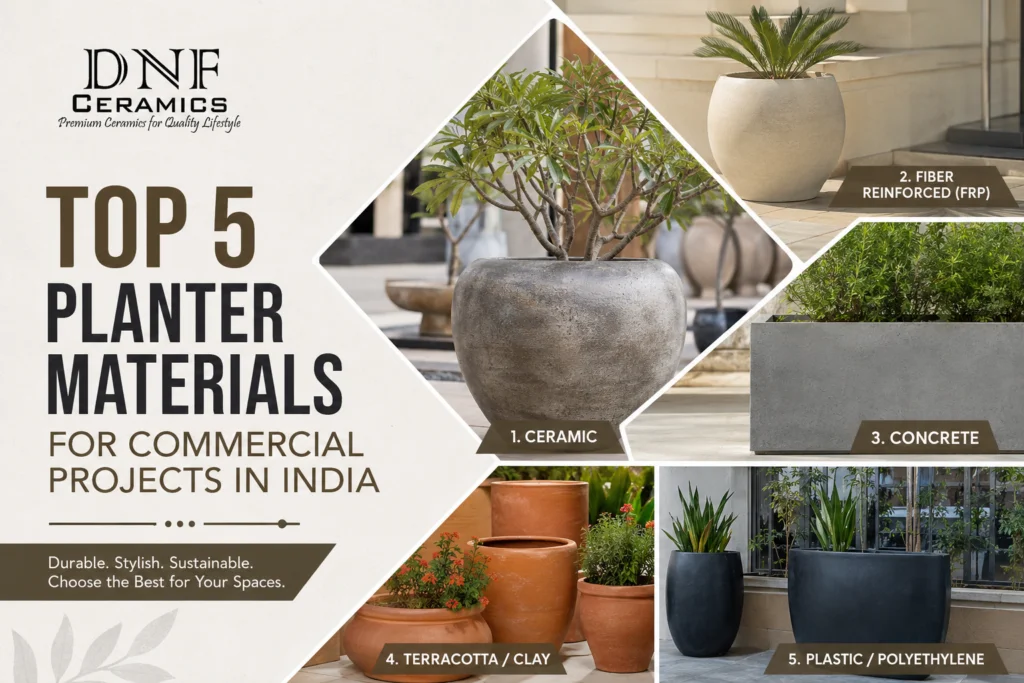
Buying ceramic pots in bulk in India — whether you are a retailer building out a category, an event planner sourcing for a season, an interior designer fitting out a project, or an international importer building a product range — requires you to understand the sourcing landscape clearly. The route you take determines your unit economics, your product quality, your customisation access, and your supply chain reliability. In 2025, the sourcing options are more varied than ever. This guide gives you the complete picture.
Option 1: Direct Manufacturer Sourcing from Khurja — The Gold Standard
For serious bulk buyers — anyone ordering 50+ pieces per variant on a recurring basis — sourcing direct from a manufacturer in Khurja is the unambiguously best route. Khurja produces approximately half of India’s ceramic output. A direct manufacturer relationship gives you: factory-direct pricing with no intermediary margin; access to the full product range including items that wholesale channels do not carry; customisation options including bespoke glaze colours, sizes, and forms; and a supply relationship that improves over time as the manufacturer understands your requirements.
The practical requirements: you need to meet MOQ thresholds per variant (typically 50 pieces for most ceramic pots, 100 pieces for terracotta, 25 pieces for FRP planters), and you need to plan 3–5 weeks ahead for production lead time. Read the MOQ guide for the full structure. For designers specifically, see how interior designers source ceramics direct from Khurja. For retailers, see our wholesale buyer’s guide.
Option 2: Khurja Trading Companies — Convenience at a Cost
Khurja-based trading companies aggregate products from multiple manufacturers and offer a curated range to wholesale buyers without requiring direct manufacturer relationships. The advantage: product variety without the complexity of managing multiple supplier relationships, and sometimes lower per-variant MOQs than direct manufacturers. The disadvantage: a trading margin of 25–40% above factory pricing, and limited customisation access. For buyers who need variety across many product types at volumes that do not justify direct manufacturer MOQs, trading companies are a starting point rather than a long-term strategy.
Option 3: IndiaMart and B2B Digital Platforms
IndiaMart, TradeIndia, and similar platforms list thousands of ceramic pot sellers — manufacturers, traders, and retailers mixed together without clear differentiation. These platforms are useful for supplier discovery and price benchmarking. They are not reliable for quality assurance — platform listings do not verify manufacturer vs trader status, product photographs are routinely shared across multiple sellers, and prices quoted without clarity on MOQ applicability are often misleading.
Use these platforms for initial research. Always request physical samples before any bulk commitment, verify the seller’s factory address and GST registration, and do not rely on platform-mediated assurances for quality. For international buyers using these platforms as a starting point, see our guide to qualifying top ceramic manufacturers in India for export.
Option 4: Delhi and NCR Wholesale Markets
Delhi’s wholesale ceramic markets — particularly in the Sadar Bazaar, Chawri Bazaar, and surrounding wholesale zones — carry ceramic pots sourced from Khurja and other regions. These markets serve buyers who need product on short notice without production lead time, or who need quantities below direct manufacturer MOQ thresholds. The trade-offs are well-understood: prices are significantly above factory-direct rates; consistency across large quantities of the same product is not guaranteed; and customisation is not available.
For event planners buying on short notice or retailers topping up stock between direct orders, market buying has a role. As a primary sourcing strategy, it is structurally expensive at any meaningful volume.
Option 5: Online Retail Platforms (Nykaa Home, Pepperfry, Urban Ladder)
Consumer platforms carry ceramic pots at retail pricing — typically 3–7x the factory price for products that originate in Khurja. These platforms serve individual consumers, not bulk buyers. There are no volume pricing structures, no MOQ-based discounts, no customisation, and no ability to build a supplier relationship. For any buyer purchasing 20 or more pieces, direct or wholesale sourcing always produces better economics. These platforms are mentioned here only to be explicitly excluded from the bulk buying consideration.
Option 6: International Import from China
Some Indian buyers import ceramic pots from China — typically for product types not manufactured domestically or where the price differential is significant after duties. In 2025, Indian import duties on ceramic goods typically range from 20–30%, and combined with sea freight costs (6–10 weeks lead time), the economics of China sourcing are unfavourable for most ceramic pot categories that are well-covered by Indian manufacturers. For overseas buyers interested in Indian-origin ceramics, see our complete import guide.
The 2025 Verdict: Source Direct from Khurja
For any bulk buyer in 2025 — retailer, event planner, designer, hotel buyer, or international importer — sourcing direct from a Khurja ceramic manufacturer remains the optimal strategy across every dimension that matters: unit economics, product quality, customisation access, and supply chain reliability. DNF Ceramics has been manufacturing ceramic pots and planters, terracotta pots, ceramic vases, and FRP planters in Khurja since 1976. We supply directly to bulk buyers of all types with no minimum on order value — only on pieces per variant. For the full range of customisation options, read Custom Ceramic Pots — How to Place a Made-to-Order Request.