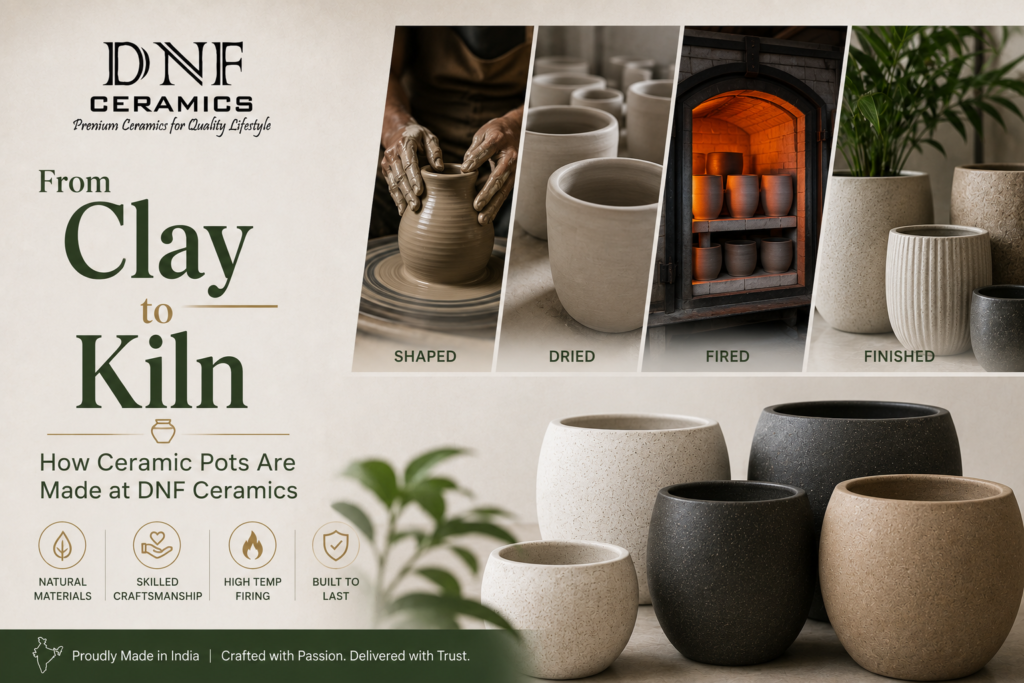
There is a particular satisfaction in understanding how something is made — especially when the object in question has been produced by human hands using skills developed over generations. For ceramic pots and planters, the manufacturing process is both ancient and precise: a sequence of carefully controlled stages where material science, craft skill, and extreme heat combine to produce a finished product capable of lasting for decades. This is how a ceramic pot is made at DNF Ceramics in Khurja — from the raw clay that arrives at our production facility to the finished, quality-checked piece that leaves our factory for your project site.
Understanding this process matters for B2B buyers. It explains why lead times are what they are, why certain customisations require sample approval, why high-temperature kiln firing produces a fundamentally superior product to low-temperature alternatives, and why handmade ceramic pots carry a quality signature that machine-made products cannot replicate.
Stage 1: Raw Material Preparation and Clay Body Formulation
Every ceramic pot begins with clay — but clay is not a single uniform material. Different clay types have different plasticity levels, shrinkage rates, firing temperatures, and fired properties. At DNF Ceramics, the clay body used for each product category is carefully formulated to achieve a specific set of characteristics: the right workability for the forming method being used, predictable shrinkage during drying and firing, and the target density, porosity, and strength in the finished piece.
Raw clay is sourced from regional deposits and processed to remove organic matter, stones, and other impurities through a series of washing, settling, and filtering stages. The cleaned clay is then blended with mineral additions — feldspar for flux, silica for structure, and other additives specific to the clay body specification — before being pugged through a mechanical clay processor. Pugging removes air pockets from the clay mass and produces a homogenous, consistently dense material ready for the forming stage. Air pockets left in clay before firing are a primary cause of structural failure during the kiln stage — pugging is a quality control measure, not just a production step.
Stage 2: Forming — Where the Artisan’s Skill Is Most Visible
Forming is the stage that most people picture when they think about pottery making — and it is where the difference between handmade and machine-made ceramic pots is most immediately apparent. At DNF Ceramics, we use several forming methods depending on the product type, scale, and design specification:
- Wheel throwing: For round pots, traditional planters, and vases, our skilled potters shape clay on a rotating wheel — centring the clay mass, opening the form, and building walls by hand as the wheel turns. Wheel-thrown pieces have subtle variations in wall thickness, surface texture, and profile that are the authentic signatures of human craft.
- Jiggering and jolleying: For tableware — plates, bowls, cups — and other symmetrical forms at production volumes, a semi-automated jigger machine profiles the clay against a rotating plaster mould. This achieves dimensional consistency across large batches while retaining the character of clay-formed ware.
- Slip casting: For complex decorative forms, sculptural planters, and pieces with undercuts or fine surface detail, liquid clay (slip) is poured into plaster moulds. The plaster absorbs moisture from the slip, and a clay wall firms against the mould surface. When the wall reaches adequate thickness, excess slip is drained and the piece is released from the mould after partial drying.
- Hand building: For our extra large planters — pieces too large to be thrown as a single unit on the wheel — our artisans hand-build the form in sections, joining walls using slip as an adhesive and blending joints by hand. This technique demands considerable skill and experience to produce consistently strong joins that survive the kiln.
To learn more about the people behind each of these techniques, read Artisan Stories — Meet the Potters Behind DNF Ceramics.
Stage 3: Drying — The Critical Waiting Stage
Freshly formed clay contains significant water content — typically 20–25% by weight — and cannot go directly into a kiln. If wet clay is fired, the rapid steam generation from evaporating water causes the piece to crack or explode. Drying must therefore proceed gradually and at a controlled rate. Too fast, and differential shrinkage between the surface and the interior creates stresses that crack the piece. Too slow, and production timelines extend beyond practical limits.
At DNF Ceramics, pieces are moved from the forming stage to covered drying racks in controlled drying rooms where temperature and air circulation are managed to produce a consistent, gradual drying rate. Larger and thicker pieces — particularly extra large planters — require longer drying periods to ensure moisture migrates uniformly from the interior to the surface before the piece is loaded into the kiln.
Stage 4: Bisque Firing — The First Kiln Pass
Once moisture content has dropped to a stable level, dried pieces are loaded into the kiln for the bisque firing. This first firing — typically at temperatures between 950°C and 1,100°C depending on the clay body — serves several purposes. It burns off remaining organic material from the clay, releases chemically bound water from clay minerals, densifies the clay structure, and produces a porous but structurally stable piece ready for glaze application. The bisque piece is strong enough to handle but still porous enough to absorb a liquid glaze coating evenly.
Stage 5: Glazing — Colour, Texture, and Surface Character
Glazing is the stage that gives ceramic pots their surface character — the colour, sheen, and texture that defines the finished piece aesthetically. At DNF Ceramics, glazes are applied by dipping, spraying, or hand-painting depending on the product and the finish specification. Our glaze range includes solid colour glazes, reactive glazes that produce natural variation and depth in the fired finish, matte finishes, satin finishes, high-gloss finishes, and speckled or textured effects.
All glazes used in our production are lead-free — a non-negotiable standard for any manufacturer supplying to the hospitality sector, retail, or export markets. For our restaurant and hotel crockery range, glaze formulation additionally meets food-safe ceramic manufacturing standards — confirmed through regular batch testing.
Stage 6: Glaze Firing — The Stage That Defines the Final Product
The glaze firing is the most technically demanding stage of the process. Glazed pieces are loaded into the kiln and fired to the target temperature — for most of our ceramic range, between 1,150°C and 1,260°C. At these temperatures, the glaze materials melt, flow across the clay surface, and fuse permanently to the clay body as the kiln cools. The specific firing temperature, the rate at which the kiln rises to peak temperature, the hold time at peak, and the cooling rate all affect the final appearance of the glaze.
Reactive glazes — which produce depth, variation, and movement in the fired surface — are particularly sensitive to firing schedule. A glaze that looks flat and uniform in the unfired state can produce complex visual effects when fired precisely. This is why high-temperature kiln firing managed by experienced kiln operators is a genuine quality differentiator — and why decades of production experience at DNF Ceramics translates directly into consistent glaze quality across large production batches.
Stage 7: Quality Control and Inspection
After firing and cooling — a process that takes several hours to complete safely — every piece is removed from the kiln and individually inspected. Our quality control process checks: glaze surface quality (no crawling, pinholes, colour inconsistency, or bare patches); dimensional accuracy against the product specification; structural integrity (no cracks, deformation, or warping); and drainage hole placement and clearance. Pieces that do not meet specification are separated, classified as seconds if the defect is minor, or rejected entirely if structural integrity is compromised. For bulk hotel and wholesale orders, additional batch-level QC is conducted against the original purchase order specification — including glaze colour matching against the approved sample. Read the full story of how DNF Ceramics maintains quality across 10,000 orders.
Stage 8: Packing and Dispatch
Finished, QC-approved pieces are individually wrapped in bubble film or foam sheeting, placed in double-walled corrugated cartons with internal dividers for fragile items, and palletised for road freight dispatch. Each carton is labelled with the product code, size, glaze specification, and purchase order reference. Export orders receive additional outer crating and desiccant packing for sea freight.
Understanding this process is directly relevant if you are planning a custom ceramic order — knowing what happens at each stage helps you set realistic expectations for sample timing, production lead time, and the level of specification detail required at the order stage.