Plastic pots are everywhere in India — in every nursery, every garden centre, every hardware store. They are cheap, light, and instantly available. For a single plant purchased on impulse, plastic is convenient. For any buyer making a deliberate, informed procurement decision — a retailer building a product category, a hotel buyer specifying for a property, a landscaper equipping a commercial installation, a designer creating an interior — plastic is the wrong choice in every dimension that matters. This guide makes the case for ceramic over plastic clearly, with specifics that apply to real procurement and design decisions.
Plant Health: The Core Argument
The most fundamental difference between ceramic and plastic is how each material behaves in relation to the plant growing inside it. Ceramic, particularly when glazed and fired at stoneware temperatures, has a thermal mass that plastic does not — it buffers the root zone against temperature extremes. In the Indian summer, a dark plastic pot in direct sunlight can reach internal temperatures that kill roots; a ceramic pot’s mass moderates this heat spike.
For unglazed terracotta pots — the other natural clay option — the plant health advantage is even more direct. The porous clay wall of terracotta allows a continuous small exchange of air between the root zone and the outside environment, preventing the anaerobic conditions that cause root rot. Plastic allows no such exchange. For the full science behind clay’s plant health advantage over plastic, read Why Terracotta is Better than Plastic for Plants. And for Do Ceramic Pots Need Drainage Holes, the answer depends on glaze type — a guide worth reading for any buyer specifying across both glazed and unglazed products.
Durability: The True Cost of Ownership
The upfront price of a plastic pot is always lower than an equivalent ceramic pot. The total cost of ownership over five years is almost always lower for ceramic. Here is why: a quality high-fired ceramic pot in an indoor setting maintains its appearance and structural integrity for decades. A plastic pot in outdoor conditions — particularly Indian outdoor conditions with intense UV, monsoon rainfall, and temperature extremes — shows visible degradation within 18–24 months. The surface chalks. The colour fades. The material becomes brittle and eventually cracks.
For a retailer, this means customers return to buy replacements frequently — which creates repeat sales but also creates a reputation problem if the product quality is associated with the store. For a hotel or commercial operator, it means repeated procurement cycles for the same positions, plus the operational disruption of managing replacement across an installed landscape. For any buyer with a 3–5 year view on their installation, ceramic’s higher upfront cost is the lower total investment.
Ceramic vs Plastic — Direct Comparison
| Factor | Ceramic Pots | Plastic Pots |
| Lifespan | Decades indoors; 10+ years outdoors with good specification | 2–5 years outdoors; visible degradation starts within 18 months |
| UV Resistance | Excellent — glaze is UV-stable glass | Poor — chalks, fades, becomes brittle under Indian UV levels |
| Thermal Mass | High — buffers root zone temperature swings | Negligible — transmits heat directly, causing root stress in summer |
| Root Aeration | Better than plastic; terracotta variant offers porosity for breathing | None — sealed, no gas exchange through pot wall |
| Root Rot Risk | Lower — especially with terracotta; better drainage management | Higher — sealed pot retains moisture; no evaporation through wall |
| Aesthetics | Premium — surface depth, weight, genuine material character | Noticeably synthetic — guests, clients, customers detect the difference |
| Indoor Suitability | Preferred for any premium interior environment | Not suitable for hotels, design-led retail, or quality interiors |
| Outdoor Suitability | Good with high-fire glaze specification | Poor — degrades rapidly under Indian outdoor conditions |
| Weight | Heavy — stable outdoors; floor load consideration upstairs | Very light — risk of tipping in wind; needs ballasting for large sizes |
| Sustainability | Natural clay — biodegradable at end of life | Petroleum-derived — persists in landfill for hundreds of years |
| Total 5-year cost | Higher upfront; lower per year from durability | Lower upfront; higher total from replacement frequency |
Aesthetics: What Plastic Cannot Replicate
In any commercial or premium residential setting, the aesthetic difference between ceramic and plastic is immediately apparent — not just to designers, but to customers, guests, and clients who cannot articulate why they perceive quality differently between two spaces. Ceramic has weight, surface depth, and material character. A reactive glaze surface shifts colour and texture in changing light. The warmth of a terracotta surface communicates earth and craft. These are qualities that any synthetic material, however cleverly textured or coloured, cannot authentically produce.
For retailers: customers purchasing premium plants or home décor instinctively select ceramic over plastic as a gift or display choice. For hotels: a lobby specification that includes plastic planters communicates budget procurement to every guest who sees it. For interior designers: a scheme with ceramic pots has a material authenticity that a plastic-filled equivalent cannot achieve. The comparison with FRP planters — which are synthetic but better quality than standard plastic — is covered in FRP vs Ceramic Planters — Which is Better for Hotels.
Sustainability: The Dimension That Is Increasingly Non-Negotiable
Plastic is petroleum-derived. It does not biodegrade in any meaningful timeframe — a plastic pot disposed of today will persist in the environment for hundreds of years. Ceramic is natural clay — a mineral material that returns fully to the earth at end of life, with no synthetic residue. For commercial buyers with sustainability commitments — hotel brands targeting LEED certification, retailers marketing to eco-conscious consumers, corporate campuses with ESG reporting — specifying ceramic over plastic is a documentable, meaningful choice.
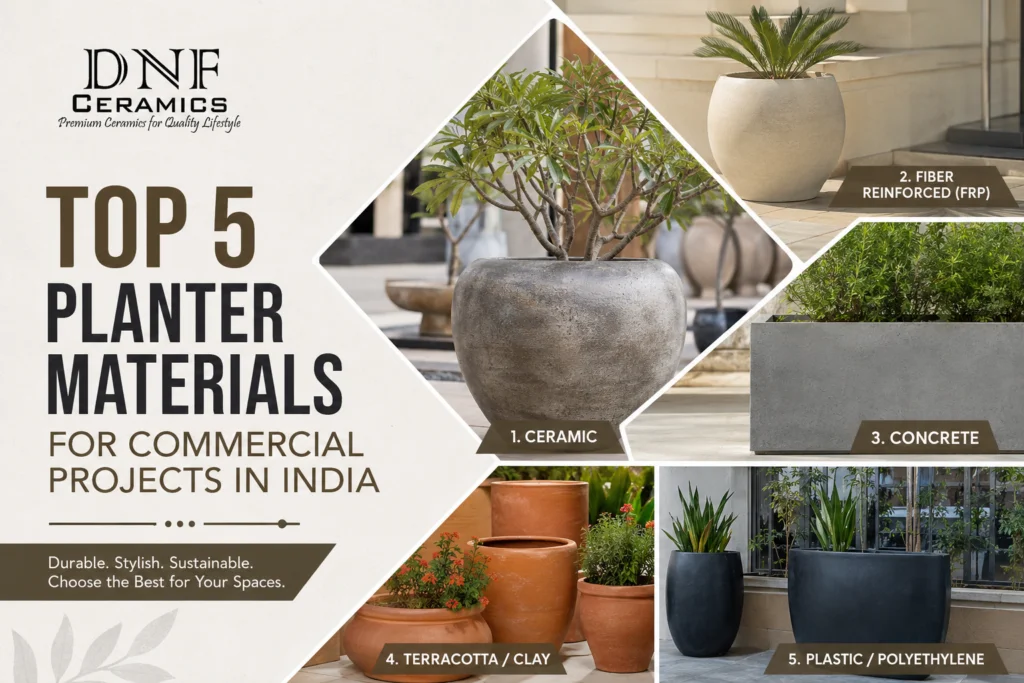
Both glazed ceramic and terracotta are fully biodegradable natural clay materials. Together with our FRP range for large-format applications where weight is a constraint, DNF Ceramics can cover almost every commercial planting requirement without specifying virgin plastic. For the full material landscape comparison, see Top 5 Planter Materials for Commercial Projects in India.
Sourcing Ceramic at Wholesale Price in India
The price premium of ceramic over plastic shrinks dramatically when ceramic is sourced direct from a manufacturer. Retail ceramic pots in India carry the margin of at minimum two or three distribution layers. Direct manufacturer sourcing from Khurja — India’s ceramic manufacturing capital — eliminates those layers entirely. DNF Ceramics supplies ceramic pots direct to retailers, hotel buyers, event planners, and interior designers at wholesale pricing. For the full retail sourcing guide, read Wholesale Ceramic Pots: A Buyer’s Guide for Indian Retailers. For the MOQ structure, see our MOQ guide. For the broadest sourcing overview, read Where to Buy Ceramic Pots in Bulk in India 2025.