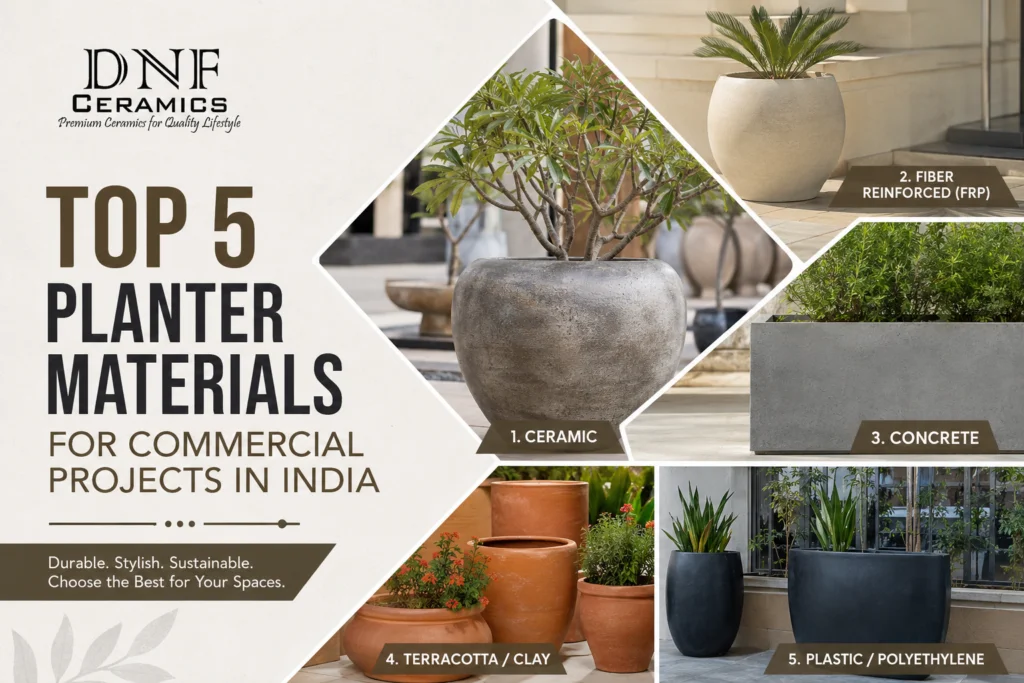
Walk into any premium hotel lobby in India and you will encounter ceramic planters. Drive up to the hotel entrance and you will likely encounter FRP. This division of materials across zones is not accidental — it reflects a genuine understanding of what each material does well and where its limitations become apparent. For hotel procurement managers, FF&E consultants, and interior designers specifying planters for a hospitality project, understanding this material boundary is one of the most practically useful decisions in the specification process. This guide covers FRP and ceramic planters in direct comparison — their physical properties, performance in different hotel environments, sustainability credentials, and procurement considerations.
Understanding FRP: Composition and Commercial Properties
FRP — Fibre Reinforced Plastic — is a composite material produced by embedding glass fibres in a polymer resin matrix, then curing under heat and pressure. The result is a material that combines relatively low weight with high structural rigidity. FRP planters can be produced in virtually any shape and at very large sizes because the manufacturing process uses moulds rather than the physical limits of a potter’s hands or a ceramic kiln. This is the critical size advantage that FRP holds over ceramic: a 150cm FRP planter is manageable; a 150cm ceramic planter is an engineering challenge.
At DNF Ceramics in Khurja, we manufacture FRP planters alongside our ceramic and terracotta ranges. Both product lines are available for specification as part of a single hotel or commercial project order, allowing one manufacturer relationship to cover both indoor and outdoor planting requirements.
Understanding Ceramic: Why It Remains the Interior Standard
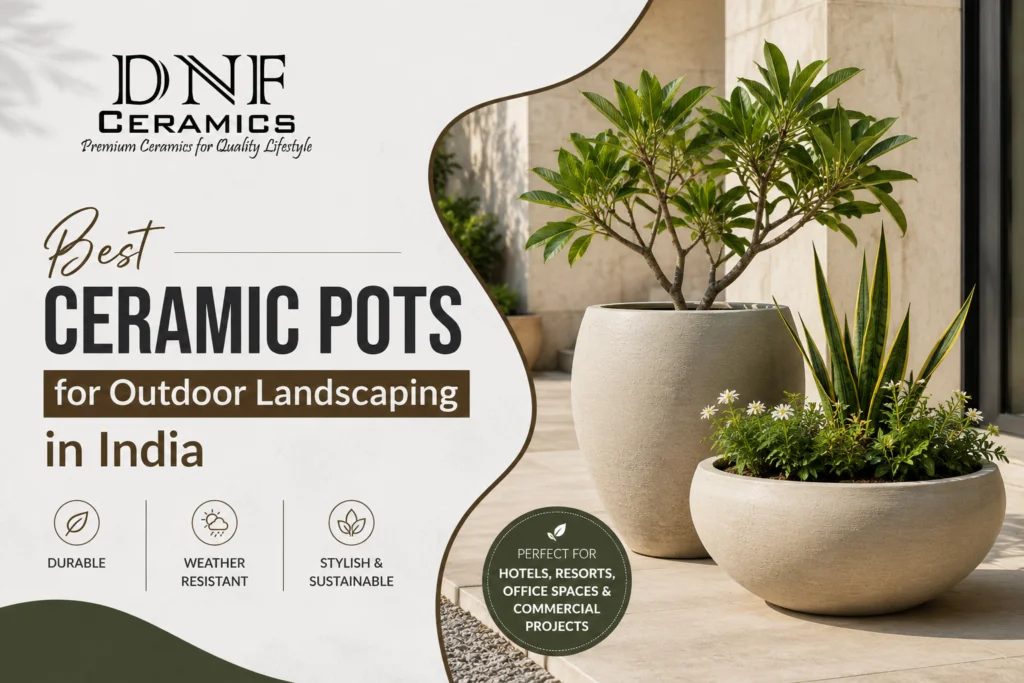
Glazed ceramic is made from refined clay fired at high temperatures — typically between 1,150°C and 1,280°C — with a glaze layer that fuses permanently to the clay body during firing. The firing process produces a dense, non-porous material with a surface quality that is genuinely different from any synthetic product. This difference is perceptible in multiple ways: the weight of a ceramic planter when moved; the depth and variation of a reactive glaze surface; the way the piece holds its finish across years of daily guest contact without the surface degradation that FRP and plastic products exhibit in interior environments over time.
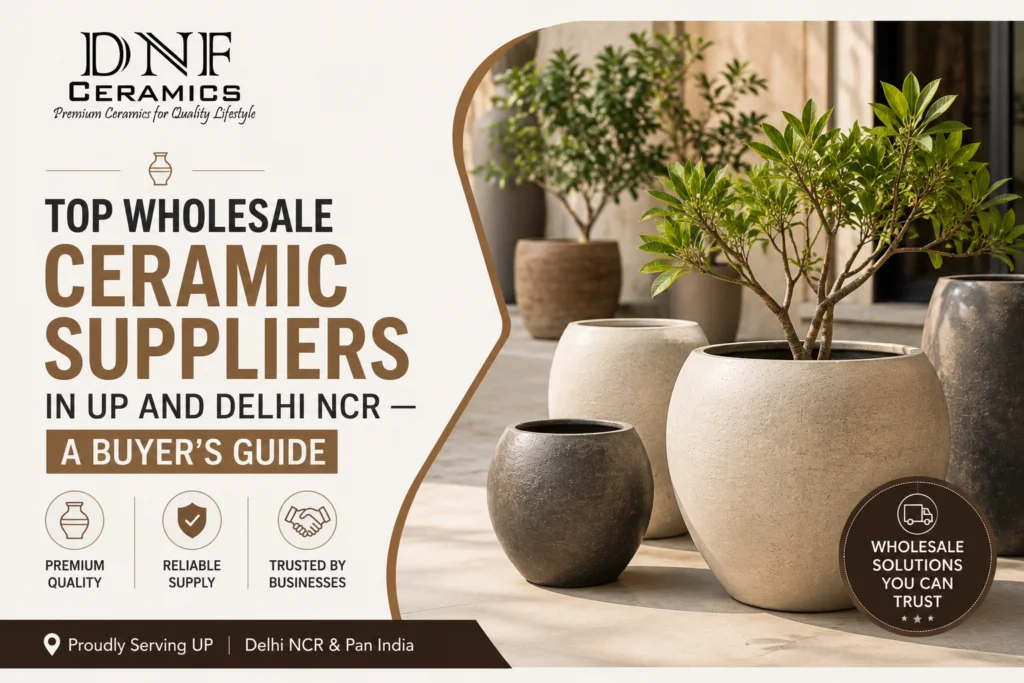
DNF Ceramics has been producing ceramic pots and planters from our Khurja facility since 1976. Our range spans compact tabletop sizes through to extra large outdoor planters for commercial landscape applications. For a guide to selecting the best ceramic styles for hotel lobbies specifically, see Best Large Ceramic Planters for Hotel Lobbies India.
Head-to-Head: FRP vs Ceramic for Hotel Environments
| Factor | FRP Planters | Ceramic Planters |
| Weight | Very light — easy to reposition and install on upper floors | Heavy — stable and permanent once placed; a structural asset indoors |
| Indoor Aesthetics | Adequate for mid-market; synthetic character detectable up close | Premium — surface depth and weight communicate quality to guests |
| Outdoor Performance | Excellent — UV-stable, rain and humidity resistant in all climates | Good with appropriate high-fire glaze; outdoor range available from DNF |
| Large Format Availability | Unconstrained — moulds allow any size | Available — DNF produces extra-large ceramic planters to 120cm+ |
| Durability (Indoor) | Risk of surface chalking/yellowing over 5–10 years indoors | Decades — high-fired glaze resists fade, scratch, and surface degradation |
| Sustainability | Synthetic composite — not biodegradable at end of life | Natural clay — fully biodegradable; LEED/GRIHA relevant |
| Customisation | Colour, shape, texture — high flexibility via mould | Glaze colour, size, finish, logo printing — custom production available |
| MOQ at DNF Ceramics | 25 pieces per variant | 50 pieces per variant (30 for tall/extra-large) |
| Standard Lead Time | 15–20 days | 15–25 days depending on size and finish |
Zone-by-Zone: Which Material for Which Hotel Space
The most effective hotel planter specifications use both materials in different zones, matched to the specific requirements of each environment. The professional zone-by-zone allocation:
- Lobby, reception, restaurant, spa, suite corridors: Glazed ceramic planters — the premium indoor environment demands the premium material. Ceramic communicates quality; FRP does not at this register.
- Hotel entrance, driveway, porte-cochère: FRP planters for large-format pieces; ceramic for statement positions where the scale is manageable
- Poolside, resort grounds, large landscape beds: FRP planters — weight, UV resistance, and large format availability make FRP the practical choice here
- Outdoor terraces, balconies, covered exterior: Ceramic with outdoor-specification glaze, or FRP depending on size and load constraints
For help deciding material by zone for your specific project, use our Planter Specification Checklist for Architects and read How to Choose the Right Planter Material for Hotel Lobbies.
The Sustainability Dimension
For hotel and resort projects pursuing LEED, GRIHA, or other green building certifications, the material specification choice between ceramic and FRP carries genuine documentation value. Ceramic is fired natural clay — a mineral material that is fully biodegradable at end of life, containing no synthetic polymers or petroleum-derived compounds. FRP is a glass-fibre and polymer composite that does not biodegrade. For any property that needs to demonstrate sustainable material choices in its certification process, specifying ceramic over FRP in indoor environments is a meaningful and documentable decision.
This sustainability angle extends to the terracotta vs ceramic comparison as well — both natural clay materials are biodegradable, but terracotta’s lower firing temperature gives it a marginally lower energy footprint in production. And compared to plastic alternatives, see Ceramic vs Plastic Pots — Why Ceramic Always Wins.
Procurement: Sourcing Both Materials from One Supplier
A practical advantage of sourcing from DNF Ceramics: both FRP and ceramic planters can be included in a single purchase order, with one point of contact, one set of logistics arrangements, and one quality control relationship. For a hotel pre-opening order covering both indoor ceramic lobby planters and outdoor FRP landscaping, this consolidation simplifies procurement significantly.
For the complete hotel planter procurement process — from specification through sampling to delivery — read How to Source Planters for Your Hotel or Resort in India. For MOQ details across both product lines, see our MOQ guide for bulk ceramic orders. For long-term care of installed ceramic planters, see the Ceramic Planter Maintenance Guide for Hotels. And for the outdoor-specific FRP guide, see Top 10 FRP Planters for Commercial Landscaping Projects.