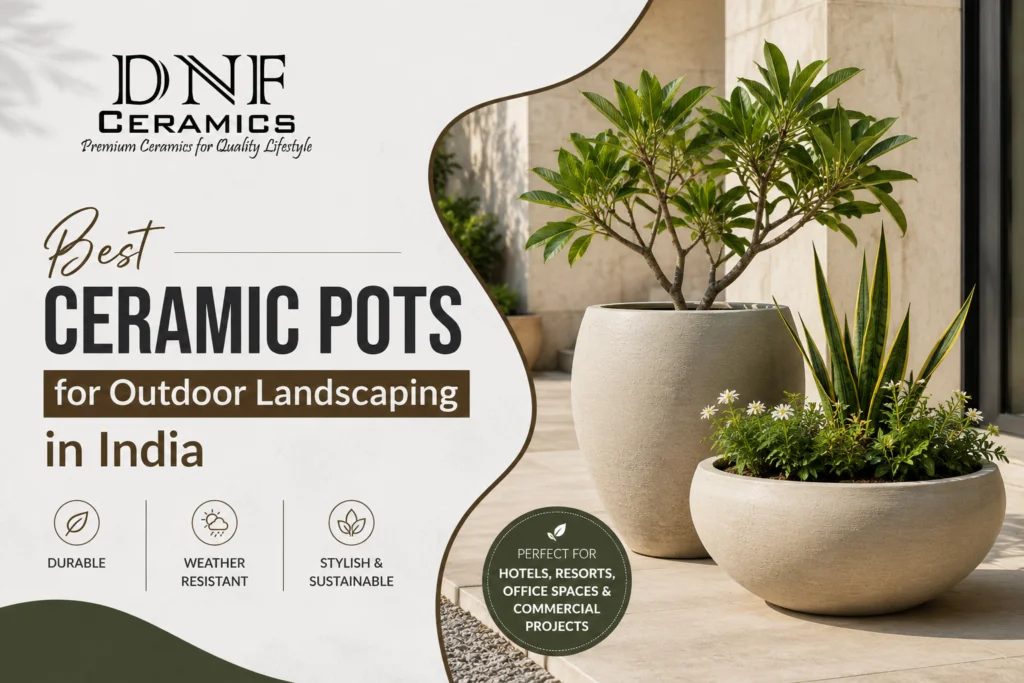
The hotel lobby planter is one of the most consequential specification decisions an interior designer or procurement manager makes. It is a permanent fixture, experienced by every guest who enters the property, and it communicates the standard of the hotel within the first few seconds of arrival — before the check-in team has said a word. A poorly chosen planter in a five-star lobby is noticed. A beautifully proportioned, well-glazed ceramic planter in the right position is felt even when it is not consciously seen — it completes the composition of the space.
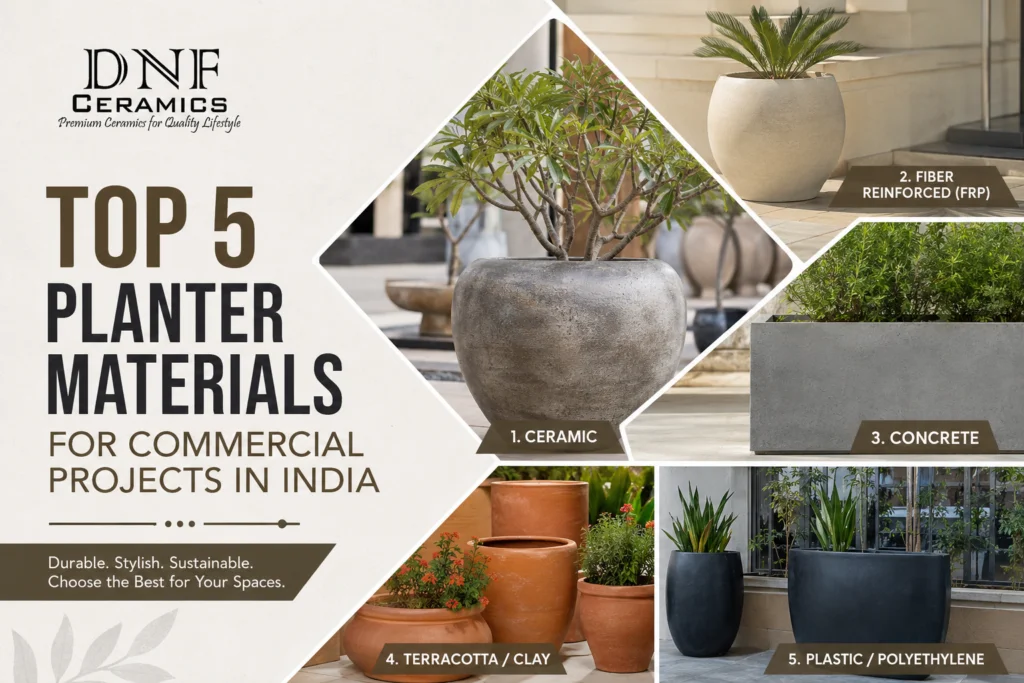
This guide covers everything you need to know about selecting large ceramic planters for hotel lobbies in India: the right material choice, the correct size and proportion parameters, the best forms for different lobby types, and how to source in bulk from a manufacturer who has been supplying the Indian hospitality sector for over 50 years. For a broader material comparison before getting into specifics, read FRP vs Ceramic Planters — Which is Better for Hotels.
Why Ceramic Is the Standard for Hotel Lobbies
In a hotel lobby, every material choice is evaluated by guests — consciously or not — against an expectation of quality. Ceramic earns its position as the lobby specification standard because of a combination of properties that no synthetic material can fully replicate.
The first is tactile quality. A high-fired glazed ceramic planter has weight, density, and surface depth that communicate quality to anyone who encounters it — even from a distance. The glaze surface catches light differently at different times of day. A reactive glaze produces subtle variation across the surface that makes each piece slightly unique. These qualities signal craft, permanence, and considered specification — exactly what a premium hotel lobby is meant to communicate.
The second is durability. Ceramic pots and planters fired at high temperatures produce a dense, non-porous body that does not yellow, chalk, fade, or degrade under UV or artificial lighting. FRP planters, while excellent for outdoor use, can develop surface chalking and colour shift over time in indoor environments. Ceramic maintains its finish for decades with appropriate maintenance. See our Ceramic Planter Maintenance Guide for Hotels for the full long-term care protocol.
Selecting the Right Size and Proportion
Scale is the most commonly misjudged variable in hotel lobby planter specification. The instinct is to order planters that look large in a product photograph — and then discover they are dwarfed by the actual lobby volume. For hotel lobbies, the working principle is: specify larger than feels comfortable on paper, and always view a sample in the actual space before confirming bulk quantities.
Specific guidelines for lobby sizing:
- Standard hotel lobby (ceiling height 4–6m): Floor planters of 80–100cm height are the baseline specification. Below 80cm, planters read as accessories rather than architectural elements.
- Double-height atrium lobby (ceiling height 6m+): Planters of 100–150cm are appropriate for primary positions. For statement feature positions at lobby entry, 120–150cm is typical at this ceiling height.
- Boutique hotel lobby (intimate scale, lower ceilings): 60–80cm floor planters work well, particularly in pairs flanking key architectural moments — entry doors, lift lobby openings, the transition between reception and lounge.
- Corridor and lift lobby: 50–70cm planters at regular intervals — typically 3–4 metre spacing — create rhythm without dominating the circulation space.
Use our Planter Specification Checklist for Architects to document exact height, diameter, drainage, and finish requirements before approaching any manufacturer.
Best Planter Forms for Hotel Lobbies
1. Tall Cylindrical Planters
The most universally specified form for hotel lobbies across India. The clean vertical line of a cylinder works with contemporary, transitional, and even classical interior styles — it is neutral enough to complement rather than compete with the interior design. Heights of 90–120cm in a straight cylinder, with a diameter of 35–45cm, are the workhorse specification for primary lobby positions. DNF Ceramics manufactures tall and extra large planters in this form in bulk from 30 pieces, in a wide range of glaze finishes.
2. Wide-Mouth Urn Planters
A more traditional form — a generous, flared opening above a narrower waist and foot. The urn shape communicates heritage, quality, and permanence without being period-specific. It is a particularly effective form for boutique hotels, palace hotels, heritage properties, and luxury resort lobbies where a classical register is appropriate. Available in handmade production from DNF Ceramics with fully custom glaze specifications.
3. Square-Section Floor Planters
For contemporary and minimalist hotel interiors, square-section floor planters offer an architectural rigidity that round forms cannot achieve. They are frequently specified in pairs for symmetrical arrangements — flanking a reception counter, a set of lift doors, or a lobby art installation. Available in ceramic and FRP at DNF Ceramics depending on size requirements and weight constraints.
4. Tapered Cone Planters
A wide-topped planter that narrows toward the base — the tapered cone reads as dynamic and contemporary. It is well-suited to all-day dining restaurants, poolside lobbies, and spa reception areas where the interior language is relaxed and flowing rather than architectural. The tapered form also allows large planting arrangements — specimen plants, layered tropical plantings, curated seasonal displays — that a narrow cylinder cannot accommodate.
5. Clustered Low Bowl Arrangements
Not all lobby planting is floor-standing. Low, wide-mouthed ceramic bowls clustered at coffee table height, in lobby seating areas, or as arrival table centrepieces create a softer, more residential quality that works well in boutique and lifestyle hotel lobbies. These are typically used as part of a layered planting scheme where tall floor planters anchor the space and low arrangements add intimacy at seated level.
Glaze and Finish Selection for Hotel Environments
The wrong finish choice in a hotel lobby is difficult and expensive to correct after installation. The guidelines that consistently hold in hospitality specification:
- Matte and satin glazes outperform high-gloss finishes in high-traffic areas — they show fingerprints, handling marks, and scuffs less readily.
- Warm neutrals (ivory, warm white, warm grey, terracotta tones) are the most universally safe choice for lobby specification — they work with almost any interior palette and do not date quickly.
- Statement colours (deep blue, forest green, charcoal black, burnt orange) work very effectively as accent pieces — one or two statement planters in a lobby of neutral-finish pieces.
- Custom glaze colours matched to specific Pantone or NCS references are available at DNF Ceramics for orders of 50 pieces or more. For the full customisation process, see Custom Ceramic Pots — How to Place a Made-to-Order Request.
Key Questions to Ask Your Manufacturer
Before confirming any bulk hotel order, verify: the clay body and firing temperature (higher temperature = greater density and durability); whether glazes are lead-free; whether drainage holes are standard or an add-on; whether custom glaze colours can be matched to a specific reference; what the breakage replacement policy is; and whether the manufacturer retains production records for future restocking. For the full production story behind DNF Ceramics’ manufacturing, read how ceramic pots are made.
How to Source and What to Budget
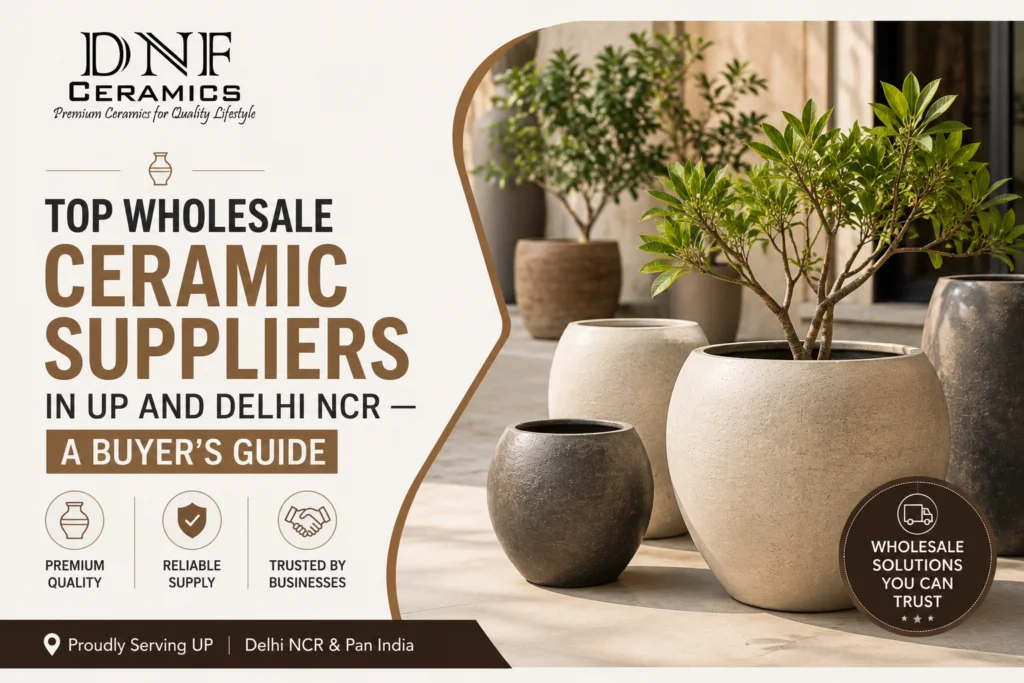
The most cost-effective source for large ceramic lobby planters in India is a direct manufacturer in Khurja — India’s largest ceramic manufacturing cluster. DNF Ceramics supplies large and extra-large ceramic planters to hotels across India from our Khurja factory, with MOQs starting from 30 pieces for tall planters. For the complete procurement process — from specification through sample approval to bulk delivery — read our hotel planter sourcing guide. For outdoor and large-format areas where FRP is appropriate, see our Top 10 FRP Planters for Commercial Landscaping Projects.