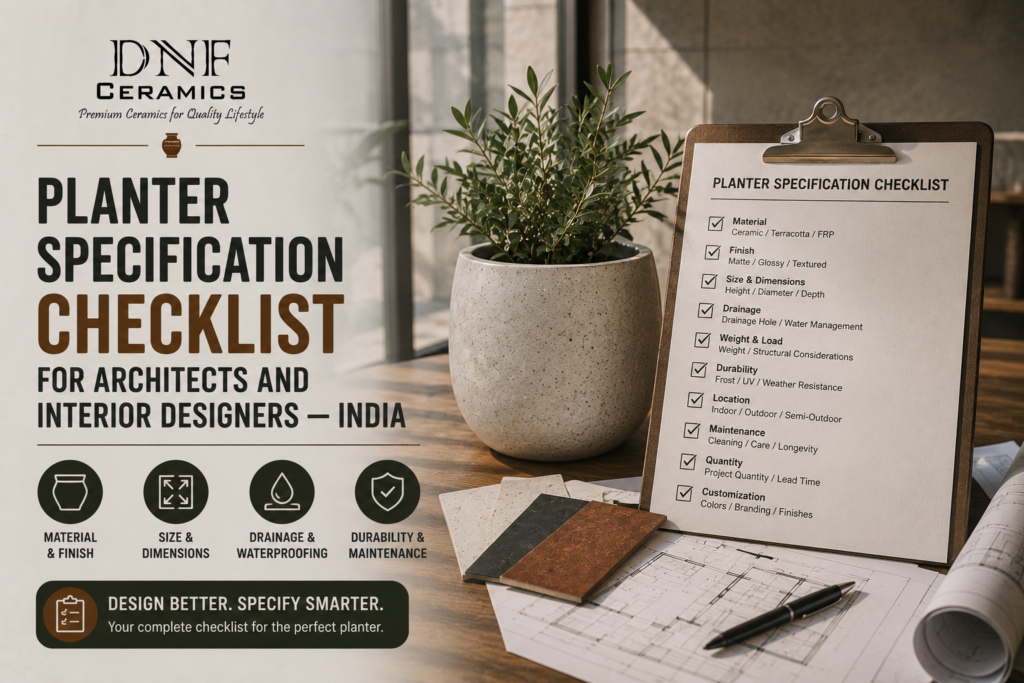
Every architect and interior designer who has specified planters for a commercial project has, at some point, submitted an incomplete specification — and paid for it with wrong deliveries, revision cycles, or delayed installation. This checklist exists to prevent that. It covers every parameter that needs to be confirmed before a planter order is submitted to a manufacturer, in the order you should think about them. Use it on every project. Adapt it to your firm’s specification templates. Share it with your procurement team.
For the background context on specification principles, read Complete Guide to Specifying Planters for Interior Projects. For material decision support, read How to Choose the Right Planter Material for Hotel Lobbies.
Section A: Material Specification
- Material type — ceramic, FRP, terracotta, or combination. Specify per zone. See FRP vs Ceramic and terracotta vs ceramic for decision support
- Clay body type (for ceramic and terracotta) — earthenware, stoneware, or porcelain. Higher fire = greater density and durability. Confirm with manufacturer
- Firing temperature — request this from the manufacturer. Minimum 1,100°C for dense glazed ceramic suitable for heavy commercial use
- Glaze type — matte, satin, high-gloss, reactive, speckled, or unglazed. Specify explicitly; do not assume default
- Glaze colour — Pantone/NCS/RAL reference for custom colours; standard colour name and manufacturer reference for range colours. Physical approval required for custom glazes
- Lead-free glaze confirmation — mandatory for hospitality, food service adjacent, and export projects. Request written confirmation from manufacturer
Section B: Dimensional Specification
- Total height (mm or cm) — overall external height of the planter including base if any
- External diameter or width and depth (mm or cm) — widest point of the pot
- Internal diameter or cavity dimensions — the actual planting space. This determines which plants can be accommodated
- Wall thickness — relevant for large planters where wall thickness affects weight and thermal mass
- Base dimensions — footprint for stability calculation and floor protection planning
- Plinth dimensions — if specifying a separate plinth, confirm dimensions are coordinated with pot base dimensions
Section C: Drainage and Water Management
- Drainage holes required — yes/no. If yes: number of holes, diameter of each hole, and placement (base centre, base perimeter)
- Sealed base — if no drainage, specify sealed base and confirm internal drainage layer requirements (gravel, membrane)
- Saucer or tray — if specifying a matching saucer, confirm diameter and that it is included in the order
- Water-tight lining — for planters on sensitive floor finishes, specify whether a fitted internal water-tight liner is required
For the full drainage decision guide, read Do Ceramic Pots Need Drainage Holes.
Section D: Weight and Structural
- Empty pot weight (kg) — request from manufacturer for each variant. Essential for upper-floor installations
- Growing medium weight estimate — approximately 0.5–1.0 kg per litre of pot volume depending on medium type
- Total installed weight — pot + medium + plant + water. Confirm against structural floor capacity for all above-ground-floor positions
- Floor protection — specify rubber feet, felt pads, or separate plinth for planters on polished or sensitive floor surfaces
- Weight reduction options — if floor load is a constraint, consider FRP planters or lightweight growing media (perlite blends, coco coir)
Section E: Quantity and Procurement
- Exact quantity per variant — piece count, not ‘approximately’. Include any spare/breakage allowance in the order quantity
- MOQ check — confirm quantities per variant meet manufacturer MOQ. See MOQ guide for DNF Ceramics thresholds
- Standard vs custom — confirm whether specification can be met from the manufacturer’s standard range or requires a custom commission. Read Custom Ceramic Pots — How to Place a Made-to-Order Request
- Lead time requirement — state your installation target date and confirm manufacturer can meet it. Read Lead Times for Bulk Ceramic Orders for reference timelines
- Sample approval — confirm a physical sample will be provided and approved before bulk production. Do not accept a photograph as sample approval
Section F: Delivery and Site
- Delivery address — full site address including any access restrictions
- Delivery floor — ground floor or upper floor; if upper floor, confirm lift dimensions and weight capacity
- Delivery window — any restricted delivery times at the site
- Floor protection on delivery — confirm whether the manufacturer’s delivery team will apply protective floor covering during unloading
- Packaging disposal — confirm responsibility for removal of packaging materials from site
Section G: After-Sales
- Restocking availability — confirm manufacturer retains production records for future replacement orders. DNF Ceramics maintains records for all commercial projects
- Breakage policy — confirm manufacturer’s policy on transit breakage claims and replacement lead time
- Maintenance guidance — request manufacturer’s written care protocol for the specific glaze and clay body specified. See How to Source Planters for Your Hotel or Resort in India for procurement context