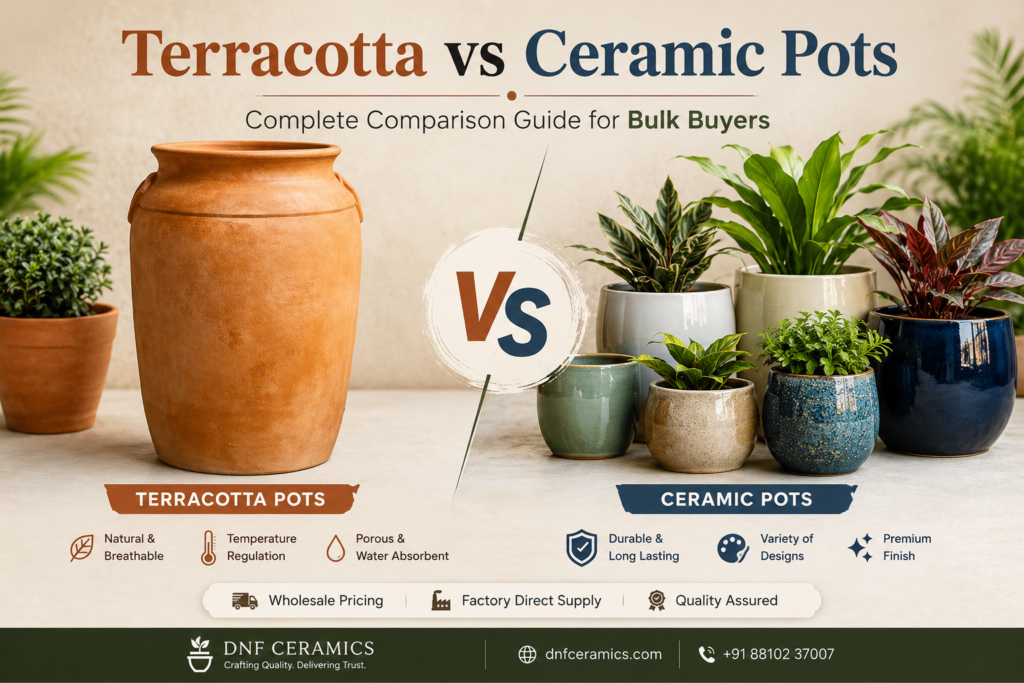
Terracotta and ceramic are both made from clay. They are fired in kilns. They both hold soil and plants. Beyond these three facts, the two materials diverge substantially — in manufacturing, in physical properties, in plant health outcomes, in durability, in aesthetics, and in the types of projects they each serve best. The persistent confusion between them leads to wrong procurement decisions: event planners ordering glazed ceramic when rustic terracotta would serve their brief better; hotel buyers defaulting to terracotta when the lobby environment calls for glazed ceramic. This guide draws a clear line between the two materials so your specification decisions are informed from the start.
The Manufacturing Difference: Temperature and What It Changes
Both terracotta and ceramic start as clay. The divergence begins in the kiln. Terracotta is fired at low temperatures — typically 900°C to 1,150°C. At these temperatures, the clay body sinters (particles begin to fuse at contact points) but does not vitrify. The result is a porous, relatively soft material with the characteristic warm reddish-brown colour that comes from the iron content in the clay. The porosity is not a defect — it is a defining functional property that gives terracotta its plant health advantages.
Ceramic is fired significantly higher — 1,100°C to 1,280°C for the stoneware range that DNF Ceramics produces. At these temperatures, the clay body undergoes near-complete vitrification: clay mineral particles transform into a glassy matrix that is dense, non-porous, and structurally hard. A glaze — a glass-forming material applied before the high-temperature firing — fuses permanently to the clay surface, creating the smooth, impermeable, coloured finish that distinguishes glazed ceramic from natural terracotta. For the full technical picture of the glaze surface and what it means for surface care and maintenance, see Glazed vs Unglazed Terracotta Pots — Which to Choose.
Terracotta vs Ceramic — Property-by-Property Comparison
| Property | Terracotta | Glazed Ceramic |
| Firing temperature | 900–1,150°C | 1,100–1,280°C |
| Porosity | High — porous clay body | Very low — near-vitrified, non-porous |
| Surface | Natural matte, earthy texture | Smooth, glossy or matte glaze finish |
| Weight | Lighter for equivalent size | Heavier — denser clay body |
| Root aeration | Excellent — air moves through pot wall | Limited — sealed by glaze layer |
| Moisture management | Evaporates excess through pot wall | Retains moisture — good for tropicals |
| Plant health (overall) | Superior for drought-tolerant species | Better for moisture-loving plants |
| Indoor aesthetics | Natural, rustic, biophilic | Wide range — contemporary to classical |
| Outdoor durability | Moderate — frost risk in severe winters | Higher — glaze provides weathering protection |
| Event/wedding use | Rustic, boho, garden, outdoor themes | Contemporary, luxury, indoor formal events |
| Sustainability | Natural clay — biodegradable | Natural clay — biodegradable |
| MOQ at DNF Ceramics | 100 pieces per variant | 50 pieces per variant |
| Price at wholesale | More affordable per unit | Slightly higher — additional production stages |
Plant Health: Why Terracotta Has the Edge
For buyers who care about plant health outcomes — not just aesthetics — terracotta’s porosity gives it a clear advantage over glazed ceramic for the majority of commonly planted species. The porous clay wall allows a continuous small exchange of air between the root zone and the outside environment, preventing the anaerobic conditions that cause root rot. Excess water evaporates through the pot wall rather than accumulating in the growing medium, creating the well-drained conditions that succulents, cacti, herbs, palms, and Mediterranean plants are adapted to.
For the full science behind this, read Why Terracotta is Better than Plastic for Plants — the argument there applies equally to the comparison with sealed ceramic. For the specific question of which material is better for succulents, see Ceramic vs Terracotta — Which is Better for Succulents. Glazed ceramic is the better choice for moisture-loving plants — ferns, peace lilies, calatheas — where you want moisture retained rather than lost through the pot wall.
Aesthetics and Application: Reading the Brief
The aesthetic application of each material follows logically from its physical character. Terracotta’s natural, earthy warmth makes it the specification choice when the brief includes words like: rustic, natural, biophilic, artisan, bohemian, organic, garden, outdoor, wellness. Wedding decoration planters for rustic or outdoor themes, restaurant and cafe interiors with natural material palettes, resort spa areas, and eco-lodge grounds are all strong terracotta applications.
Glazed ceramic serves a completely different brief: contemporary, premium, luxury, minimal, modern, formal. Hotel lobbies, high-end residential interiors, upscale restaurant dining rooms, corporate reception areas, and ceramic pots and planters for sophisticated event styling all call for glazed ceramic. The glaze’s surface depth, colour precision, and visual cleanliness are exactly what these environments require.
Sustainability: Both Win, for Different Reasons
Both terracotta and glazed ceramic are natural clay materials — fully biodegradable at end of life, free of synthetic polymers and petroleum compounds. Compared to FRP vs ceramic or the broader ceramic vs plastic debate, both clay-based materials are clearly the more sustainable specification. Between the two, terracotta has a marginally lower production energy footprint because its lower firing temperature requires less kiln energy per batch. For LEED-sensitive or sustainability-reporting commercial clients, both materials are documentably eco-friendly — neither needs to be justified.
Can You Order Both from DNF Ceramics?
Yes — and this is the common approach for retailers stocking both product lines, event planners who serve multiple brief types, and hotel buyers who need terracotta for exterior garden areas and ceramic for interior lobby spaces. Terracotta pots and ceramic pots and planters can both be included in a single purchase order from DNF Ceramics’ Khurja facility. For the MOQ structure across both categories, read our MOQ guide for bulk ceramic orders. For interior designers establishing their first direct sourcing relationship, see How Interior Designers Can Source Ceramics Direct from Khurja. For the broader sourcing landscape, see Where to Buy Ceramic Pots in Bulk in India 2025.