The Indian outdoor environment is one of the most demanding on the planet for planter materials. Twelve months of intense UV radiation in most of the country. Monsoon rainfall of 100–300mm in a single day across large parts of India. Temperature swings of 30°C between summer and winter in the north. Salt air and high humidity along thousands of kilometres of coastline. Any planter material specified for outdoor use in India must be able to handle this combination — and the material choice matters for how the planter performs, how long it lasts, and what the total cost of ownership looks like over a ten-year installation.
This guide compares ceramic and resin planters specifically for outdoor use in Indian conditions — covering UV stability, monsoon performance, thermal behaviour, plant health, weight considerations, and the sustainability dimension that is increasingly relevant for commercial and hospitality buyers. For the broader material landscape, see Top 5 Planter Materials for Commercial Projects in India.
What Is Resin in the Context of Planters?
‘Resin planter’ covers a broad range of products in the Indian market — from simple injection-moulded plastic (polypropylene or polyethylene marketed as ‘resin’), through higher-quality fibreglass-reinforced resin, to premium cast stone resin composites that convincingly mimic natural stone. The quality, performance, and price vary dramatically across this spectrum. For the purposes of this comparison, we address the two most relevant categories for commercial and residential outdoor use: standard resin/plastic planters at the lower end, and fibreglass-reinforced resin (FRP) at the higher end. DNF Ceramics manufactures resin pots and planters as well as FRP planters — both categories are part of our product range.
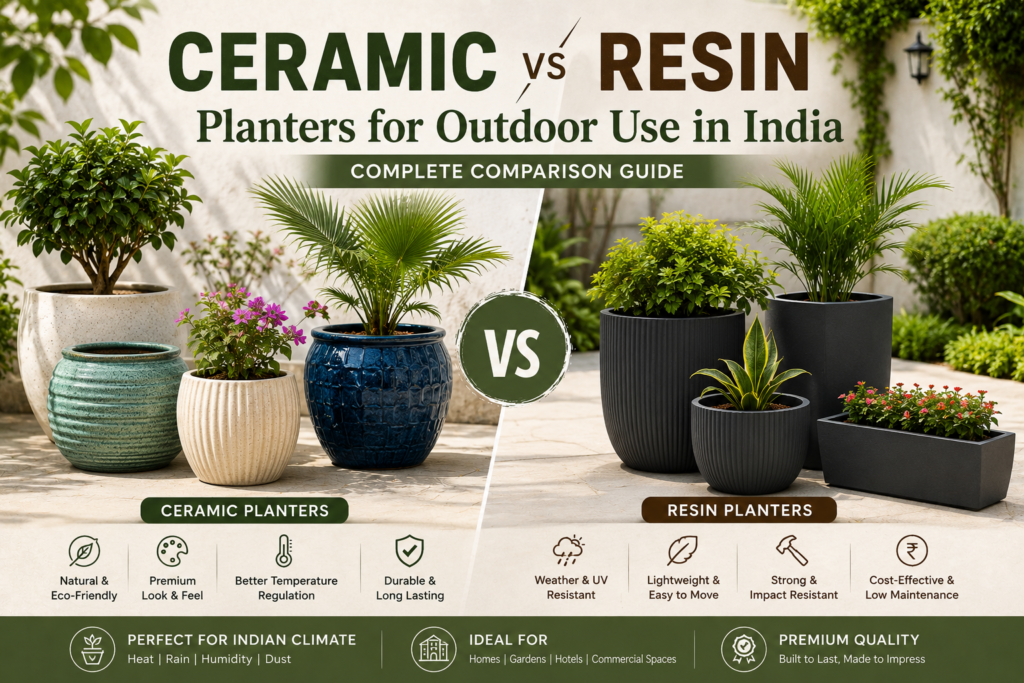
Ceramic vs Resin — Outdoor Performance Comparison
| Factor | Ceramic (High-Fired) | Standard Resin/Plastic | FRP (Fibreglass Resin) |
| UV Resistance | Excellent — glaze is UV-stable, does not fade or chalk | Poor — yellows, chalks, becomes brittle in 2–4 years | Good — UV-stabilised formulations maintain colour |
| Monsoon Performance | Excellent with drainage — sealed glaze resists water damage | Adequate — plastic does not absorb water | Excellent — impervious to moisture |
| Thermal Behaviour | High thermal mass buffers root zone temperature swings | Low mass — transmits heat directly to roots | Moderate mass — better than plastic, less than ceramic |
| Root Health | Good — especially terracotta variants with porosity | Poor — sealed, no aeration, heat stress risk | Adequate — light and non-porous, manageable |
| Weight | Heavy — stable in wind; floor load concern for terraces | Very light — may tip in strong winds | Light — ideal for terraces and rooftops |
| Outdoor Durability | Decades with appropriate specification | 2–5 years before visible degradation | 10+ years with UV-stabilised formulation |
| Large Format | Available — DNF produces 100cm+ outdoor ceramic planters | Limited — large plastic pots structurally weak | Excellent — any size achievable via moulding |
| Sustainability | Natural clay — biodegradable | Petroleum-derived — not biodegradable | Synthetic composite — not biodegradable |
| Cost | Higher upfront — lower 10-year ownership cost | Low upfront — higher replacement cost | Mid-range — best cost-performance for large outdoor |
UV Performance: Where Resin Fails and Ceramic Holds
India’s UV index regularly reaches 10–12 in summer across most of the country — some of the highest levels on earth. This UV intensity is one of the most destructive forces acting on outdoor planter materials. Standard resin and plastic planters begin to show UV degradation within 18–24 months of outdoor installation in most Indian locations: the surface becomes chalky, colours fade from saturated to washed-out, and the material becomes increasingly brittle, ultimately cracking or crazing under thermal stress.
Glazed ceramic is not affected by UV in this way. The glaze surface is essentially glass — chemically inert and UV-stable. A high-fired ceramic planter installed outdoors will not yellow, chalk, or become brittle from UV exposure. The glaze may very gradually lose its sheen over many years of direct sun exposure, but this is a cosmetic change over a decade, not the structural degradation that plastic undergoes in 2–3 years. For the best outdoor ceramic styles that make the most of this durability advantage, read Best Ceramic Pots for Outdoor Landscaping India.
Monsoon Performance and Drainage
The Indian monsoon delivers rainfall events that no planter specification can ignore. Planters without drainage in a monsoon environment become temporary water features — and the plants inside them die from root rot within days of prolonged waterlogging. The critical specification rule for any outdoor planter in India, regardless of material: drainage holes are mandatory. For the full drainage discussion, read Do Ceramic Pots Need Drainage Holes.
Ceramic’s sealed glaze surface performs well in monsoon conditions — it does not absorb water, swell, or degrade from repeated wetting and drying cycles. Standard resin/plastic also performs adequately in terms of material durability under rain, though the structural integrity of large plastic pots can be compromised when the material is UV-degraded and then subjected to the thermal shock of cool monsoon rain after a hot dry period.
Weight: When Ceramic Is Too Heavy and Resin Is Too Light
Weight is the variable that most often determines the final material choice for outdoor installations. Ceramic is heavy — a 100cm ceramic outdoor planter may weigh 35–50kg empty, rising to 80–120kg when filled with growing medium and a specimen plant. This weight is an asset for stability in wind but a constraint for rooftop terraces, elevated podium gardens, and upper-floor balconies where structural load capacity limits the specification.
Standard resin planters are very light — so light that large pieces can be unstable in strong wind without ballasting. FRP planters occupy the optimal middle ground for large outdoor commercial applications: significantly lighter than ceramic for equivalent size, but more structurally rigid than standard resin. For large-scale outdoor commercial landscaping where weight is the binding constraint, see Top 10 FRP Planters for Commercial Landscaping Projects. For extra large outdoor ceramic planters where weight is acceptable, browse our full range.
Sustainability: The Growing Specification Factor
For commercial buyers with sustainability reporting requirements — hotel chains targeting green certifications, corporate campuses with ESG commitments, retail brands marketing to eco-conscious consumers — the material choice between ceramic and resin has documented environmental implications. Ceramic is natural clay, biodegradable and free of petroleum-derived content. Resin and FRP are synthetic materials that do not biodegrade. For the broader sustainability case for natural clay materials, see Ceramic vs Plastic Pots — Why Ceramic Always Wins, and compare with FRP vs ceramic for the indoor vs outdoor application context.
The Decision Framework for Outdoor Specifications
For most outdoor commercial specifications, a zone-by-zone approach using both ceramic and FRP/resin produces the best outcome: ceramic where size, weight, and access allow; FRP where large format or weight constraints make ceramic impractical; terracotta where the design brief calls for natural aesthetics. DNF Ceramics manufactures all three — ceramic, FRP, and terracotta — allowing a complete outdoor planting specification from a single supplier.