FRP and GRC are the two materials that dominate large-scale commercial planter specification for outdoor and architectural applications in India. Both are manufactured composite materials — not natural clay or stone — and both serve the large-format, high-volume market that ceramic and terracotta cannot practically reach. But they are not interchangeable. FRP (Fibre Reinforced Plastic) and GRC (Glass Reinforced Concrete) have fundamentally different material compositions, weight profiles, aesthetic registers, and cost structures. Architects, landscape designers, and procurement managers who understand the distinction make better specification decisions. This guide draws the comparison clearly.
What Is FRP?
FRP — Fibre Reinforced Plastic — is made by embedding glass fibres in a polyester or vinyl ester resin matrix and curing under heat. The manufacturing process uses moulds, which allows FRP to be produced in virtually any shape, size, or surface texture. The material is very lightweight relative to its structural rigidity — a 120cm FRP planter might weigh 10–18kg, compared to 60–100kg for an equivalent GRC piece. FRP can be surface-treated to mimic concrete, stone, terracotta, or metal, and it accepts pigment well for a wide colour range.
At DNF Ceramics, we manufacture FRP planters and extra large outdoor planters in FRP for commercial landscaping projects across India. Our FRP range is UV-stabilised for outdoor performance in Indian climate conditions. For the top FRP styles in commercial landscaping, see Top 10 FRP Planters for Commercial Landscaping Projects.
What Is GRC?
GRC — Glass Reinforced Concrete — is made by spraying or casting a mixture of Portland cement, fine sand, water, and alkali-resistant glass fibres into a mould. The fibres reinforce the cement matrix in the same way that steel rebar reinforces structural concrete, producing a material that is significantly stronger in tension than plain concrete while being considerably thinner-walled and lighter. GRC has the surface character of concrete — the texture, density, and colour range of cement-based materials — because it essentially is concrete, just thinly formed and fibre-reinforced.
GRC is specified when the design brief requires genuine concrete aesthetics — the raw material weight of a brutalist-influenced contemporary building, the earthy grey of a landscape architecture-led project, the heavy permanence of a monumental garden installation. For the broader clay vs concrete material debate, read Clay vs Concrete Pots — What’s Right for Your Project.
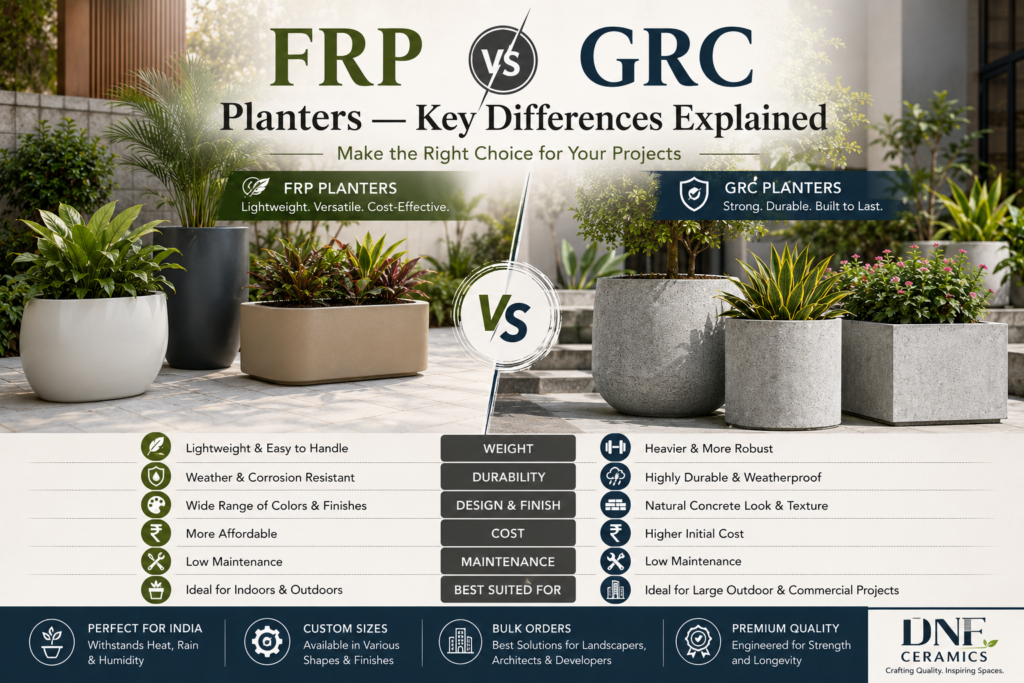
FRP vs GRC — Side-by-Side Comparison
| Factor | FRP Planters | GRC Planters |
| Material base | Fibreglass + polyester/vinyl ester resin | Portland cement + fine sand + AR glass fibres |
| Weight | Very light — 8–20kg for large formats | Moderate to heavy — 30–80kg for equivalent size |
| Aesthetic | Can mimic concrete, stone, terracotta, or solid colour | Genuine concrete character — texture, porosity, earthy grey |
| Design flexibility | Extremely high — any shape via moulding | High — moulded forms; less surface texture variety than FRP |
| Surface texture | Applied texture; can be highly decorative | Inherent cement surface — authentic raw material quality |
| Durability | 10–20 years with UV-stabilised formulation | 25–50 years — concrete durability profile |
| Frost resistance | Good — flexible material resists cracking | Excellent when properly formulated — cement does not flex |
| UV performance | Good with UV stabiliser; risk of chalking without | Excellent — concrete is not UV-sensitive |
| Cost | Lower upfront cost per unit | Higher unit cost — more material and labour intensive |
| MOQ | Lower — suitable for smaller commercial orders | Higher — often requires bespoke production runs |
| Lead time | 15–20 days standard | 20–35 days depending on mould complexity |
| Sustainability | Synthetic — not biodegradable | Cement-based — high embodied carbon in production |
When to Specify FRP
FRP is the correct specification when: the design brief requires a wide range of colours or non-concrete surface finishes; weight is a structural constraint (rooftop gardens, elevated terraces, podium landscapes); the project requires a large number of identical pieces at a competitive per-unit cost; or the installation needs to be repositioned or moved periodically. FRP planters are also the practical choice when the project is operating on a commercial landscaping budget where GRC’s higher unit cost would make the specification financially unviable for the required volumes.
When to Specify GRC
GRC is the correct specification when: the design brief explicitly requires genuine concrete aesthetics that FRP’s applied textures cannot authentically replicate; the installation is permanent and the long-term durability profile of GRC justifies its higher unit cost; the project is a high-budget architectural statement where material authenticity carries more weight than cost per unit; or the design involves very thick-walled or monolithic forms where GRC’s structural compression strength is an advantage.
For the majority of commercial hospitality and corporate landscape projects in India — hotel grounds, resort gardens, corporate campuses, shopping mall exteriors — FRP delivers the required aesthetic and performance at a more accessible cost and with more design flexibility than GRC. GRC is genuinely superior in a smaller set of premium architectural applications where it cannot be substituted.
Can You Combine FRP and Ceramic in One Project?
Yes — and this is the standard approach for full hotel and resort specifications. Ceramic planters for indoor guest-facing environments; FRP for large outdoor landscaping; ceramic or terracotta for feature positions where natural material quality matters. For the full comparison of all material options across a complete commercial project, see Top 5 Planter Materials for Commercial Projects in India. For the hotel lobby ceramic specification specifically, see FRP vs Ceramic Planters — Which is Better for Hotels.
DNF Ceramics manufactures FRP planters and the full ceramic and terracotta range from our Khurja facility. Both product lines can be included in a single purchase order. For the complete procurement guide, read How to Source Planters for Your Hotel or Resort in India. For our full specification checklist, see Planter Specification Checklist for Architects India. For the MOQ structure across both product lines, see our MOQ guide.