Plastic pots dominate the mass market for one reason: they are cheap to produce and cheaper to ship. But for anyone who genuinely cares about plant health — or who supplies plants and pots to customers who do — the comparison between terracotta and plastic is not remotely close. Terracotta wins on plant health outcomes, on longevity, on aesthetic quality, and on environmental credentials. The science behind each of these advantages is well-established, and understanding it makes you a more confident buyer, a more authoritative retailer, and a better advocate for your plants.
This guide covers the complete case for terracotta over plastic across every dimension that matters. For a comparison of terracotta against ceramic — the other major natural clay material — read our full terracotta vs ceramic comparison.
The Core Difference: Porosity and What It Means for Plants
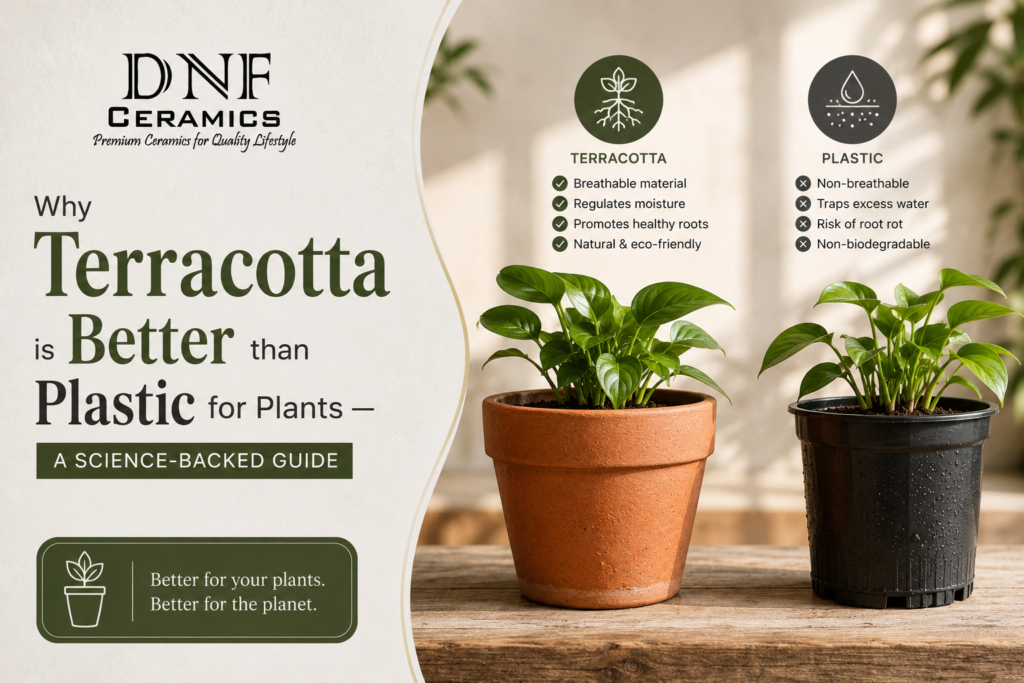
The single most important difference between terracotta and plastic pots is their porosity — and this one variable explains most of the differences in plant health outcomes between the two materials.
Terracotta is an unglazed, fired clay product. At the kiln temperatures used in terracotta production — typically 900°C to 1,150°C — the clay body densifies but retains a porous structure. Microscopic channels in the pot wall allow a small but continuous movement of air and water between the root zone inside the pot and the outside environment. Plastic is completely non-porous: it creates a sealed capsule around the root zone with no gas or moisture exchange through the pot wall itself.
This distinction has cascading consequences for plant health — in root oxygenation, moisture management, temperature regulation, and disease resistance — that we cover in detail below. For the surface finish question specifically, and its implications for moisture management, read Glazed vs Unglazed Terracotta Pots — Which to Choose.
Root Oxygenation: The Factor Most Buyers Never Consider
Plant roots require oxygen to perform cellular respiration — the biochemical process by which root cells generate energy for growth, nutrient absorption, and water uptake. In a plastic pot, the growing medium is the only source of oxygen for roots, and as the growing medium compacts with each watering cycle and settles over time, oxygen availability in the root zone steadily decreases. The result is progressively sluggish growth, reduced nutrient uptake, and increased susceptibility to root pathogens.
In a terracotta pot, the porous clay wall provides a supplementary pathway for oxygen into the root zone. Air moves through the clay at a rate governed by the thickness of the pot wall and the moisture content of the clay — when the clay is dry, airflow is higher; when wet, lower. This creates a self-regulating system: the pot breathes most freely when the growing medium has dried down and roots need oxygen most. The practical outcome is more robust root systems, faster growth in actively growing species, and significantly lower risk of the anaerobic root zone conditions that cause disease.
Moisture Management and Root Rot Prevention
Root rot is one of the most common causes of plant loss across all settings — from domestic windowsill collections to large commercial plantscaping installations. It is caused by persistently waterlogged soil, which deprives roots of oxygen and creates the conditions in which Phytophthora, Pythium, and other root-rotting pathogens thrive. Terracotta pots actively counter root rot through two mechanisms.
The first mechanism is evaporative moisture loss through the pot wall. When the growing medium is wet, moisture migrates through the porous clay and evaporates from the outer surface. This draws excess water away from the root zone and accelerates the drying-down cycle between waterings — reducing the total time roots spend in wet conditions. The second mechanism is that the lower moisture retention of terracotta naturally encourages growers to water less frequently, further reducing root rot risk.
For the most common plants specified in commercial and hotel settings — succulents, cacti, Mediterranean herbs, palms, and Mediterranean shrubs — this moisture management behaviour is particularly valuable. See Ceramic vs Terracotta — Which is Better for Succulents and Best Planters for Areca Palm for species-specific guidance. For the drainage question across both terracotta and ceramic pots, read Do Ceramic Pots Need Drainage Holes.
Thermal Regulation: Protecting Roots from Heat Stress
In outdoor settings across most of India — particularly in the northern plains, the Deccan plateau, and coastal regions — summer afternoon temperatures routinely exceed 40°C. A dark-coloured plastic pot in direct sunlight on a south-facing terrace can reach internal temperatures well above 50°C — conditions that actively denature root cell proteins and kill roots in the outer zone of the growing medium. Even lighter-coloured plastic pots transmit heat rapidly because their thin walls have very low thermal mass.
Terracotta has significantly higher thermal mass than plastic. The clay body absorbs heat slowly over the course of a hot day, moderating the peak temperature inside the pot, and releases stored heat gradually during cooler periods — buffering the root zone against both the heat spikes and the cold overnight drops that extreme temperature variation produces. This thermal buffering effect is particularly valuable for outdoor plantscaping in the commercial and hospitality sector — hotel terrace gardens, resort ground plantings, and restaurant outdoor dining areas. For North India’s winter context, see How to Winterize Your Outdoor Terracotta Pots in North India.
Longevity and True Cost of Ownership
A quality terracotta pot, produced at appropriate firing temperatures and cared for correctly, has a functional lifespan measured in decades. Terracotta used in ancient Mediterranean and South Asian civilisations has survived centuries in archaeological contexts. The ceramic craft tradition in Khurja has produced functional pottery for over 300 years — much of it still in service long after its original purpose has changed.
A plastic pot in outdoor Indian conditions typically shows visible degradation — brittleness, chalking, UV discolouration, and structural failure — within 3–5 years. The initial unit cost of terracotta is higher. But the total cost of ownership over a 10-year period, accounting for replacement frequency, is substantially lower for terracotta than for plastic. For commercial buyers — hotel procurement teams, landscape contractors, corporate facilities managers — this long-horizon cost perspective is directly relevant to procurement decisions. For the broader sourcing picture, see where to buy terracotta pots in bulk in India.
The Sustainability Dimension
Terracotta is natural clay — a mineral material derived from the earth that returns fully to the earth at end of life. It contains no synthetic polymers, no petroleum derivatives, and no materials that persist in the environment after disposal. Plastic pots are derived from petroleum, are generally not recyclable through standard municipal systems in India, and persist in landfill or the environment for hundreds of years after disposal.
For corporate and hospitality buyers with sustainability reporting requirements, the material specification choice between terracotta and plastic is a documentable, meaningful ESG decision — not a marginal preference. Hotels targeting LEED or GRIHA certification, retail brands with sustainability commitments, and corporate campuses with environmental management systems all have concrete reasons to specify terracotta over plastic wherever plant health and application requirements are met. For the full sustainability argument extended to ceramic as well, read Ceramic vs Plastic Pots — Why Ceramic Always Wins.
When Plastic Still Has a Role
A balanced guide acknowledges the genuine advantages of plastic where they exist. Plastic pots are substantially lighter — a critical factor for rooftop gardens, upper-floor balcony installations, and any application where the structural load capacity of the supporting surface is constrained. Plastic is also appropriate for plants that require consistently high moisture levels — large tropical aroids, carnivorous plants, and aquatic species where the sealed environment of plastic is an advantage rather than a disadvantage. And for very large-scale commercial installations where weight is the binding constraint, FRP planters offer some aesthetic qualities of ceramic with a significantly lower weight. But for the vast majority of plant species in the vast majority of applications, terracotta outperforms plastic in every dimension that matters.