Buying ceramic pots in bulk in India is not as simple as placing a large online order. The sourcing route you choose determines not just the unit price you pay but the quality you receive, the customisation options available to you, the lead time you can work with, and the reliability of supply over time. A retailer who has found a trustworthy direct manufacturer has a structural cost and quality advantage over a competitor who is buying through intermediaries — and that advantage compounds with every order. This guide maps out all the main options available to bulk buyers in India, with a frank assessment of the advantages and disadvantages of each route.
Option 1: Source Direct from a Manufacturer in Khurja
This is the gold standard for any serious bulk buyer of ceramic pots in India, and the option that delivers the most value across every dimension that matters: price, quality control, customisation, and long-term supply reliability.
Khurja, Uttar Pradesh, is India’s largest ceramic manufacturing cluster — producing roughly 50% of the country’s total ceramic output. Read the full story in Khurja: The Ceramic Capital of India. The practical implication for buyers is that the best ceramic products in India — at the best prices — originate here. Every layer of distribution between the Khurja factory and the buyer adds cost without adding value.
What direct manufacturer sourcing gives you: factory-direct pricing with no trading margin; direct access to the production team for all customisation and quality decisions; the ability to visit the production facility and physically inspect quality before committing to large volumes; production records maintained for future restocking; and a supplier relationship that improves over time as the manufacturer understands your requirements better with each order.
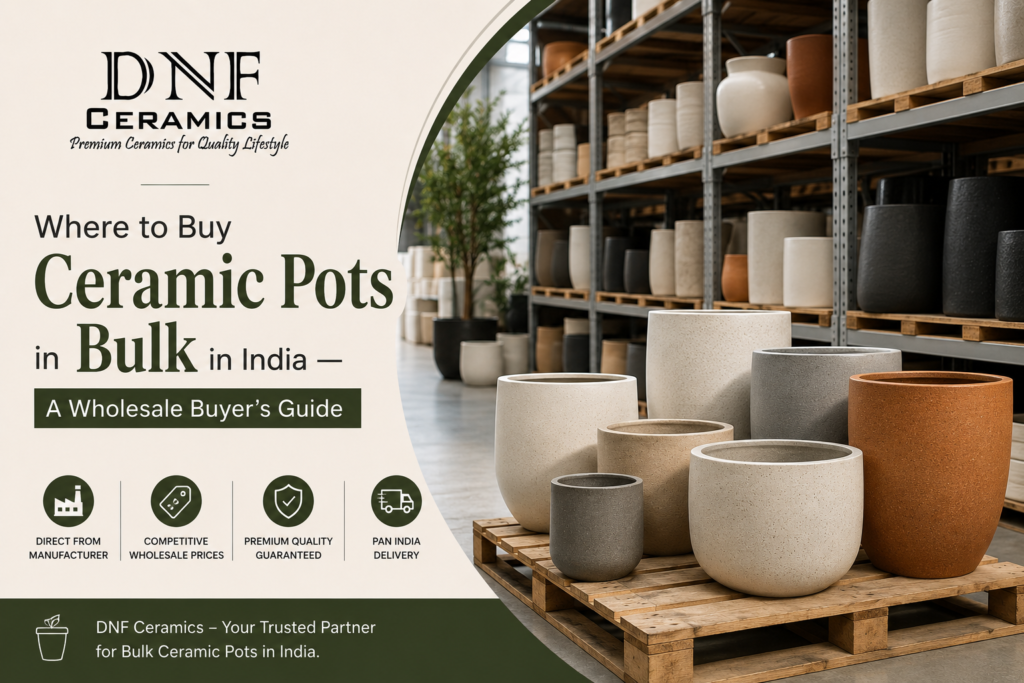
DNF Ceramics has been manufacturing ceramic pots and planters, terracotta pots, ceramic vases, and FRP planters in Khurja since 1976. We supply directly to retailers, event planners, interior designers, hotel procurement teams, and wholesale buyers across India and internationally.
The one consideration: direct sourcing requires you to clear MOQ thresholds per product variant. For the complete breakdown of how MOQs work at DNF Ceramics and how to structure your order to work within them, read our MOQ guide for bulk ceramic orders.
Option 2: Buy Through a Khurja-Based Trading Company or Agent
Trading companies based in Khurja — or agents in major cities who source from Khurja — buy from multiple manufacturers and aggregate a curated range for resale. The advantage for buyers: you can access a diverse range of product types and styles without managing direct relationships with multiple individual factories. The disadvantage: you pay a trading margin, typically 25–45% above factory-direct pricing, for this convenience.
Customisation through a trading company is limited to what the company already offers from its manufacturing relationships. If you want a custom glaze colour, a non-standard size, or a unique form, a trading company cannot easily accommodate this without acting as a go-between — adding time, cost, and communication friction to the process. For buyers who require variety across many product types in quantities below direct manufacturer MOQs, a trading company may be a practical starting point. For anyone ordering 50+ pieces of any single variant, direct manufacturer sourcing is clearly the better route.
Option 3: IndiaMart and B2B Online Platforms
IndiaMart, TradeIndia, and similar B2B platforms list thousands of ceramic pot and planter sellers across India — including manufacturers, traders, and retailers. These platforms are genuinely useful for initial market research and supplier discovery. They allow you to quickly understand the price range for a given product type, identify potential suppliers in a specific region, and make initial contact inquiries at scale.
The challenge is verification. Platform listings do not reliably distinguish between manufacturers and middlemen. Photographs can be misleading — the same images appear on multiple listings from different sellers. Prices are often quoted without clarity on whether MOQ applies. Quality is impossible to assess without physical samples. The platform’s own interest is in generating inquiries, not in guaranteeing supplier legitimacy.
Use these platforms for discovery and benchmarking. Never confirm a bulk order without physically visiting the factory, receiving and approving samples, and verifying the supplier’s GST registration and business credentials.
Option 4: Delhi and NCR Wholesale Markets
Delhi’s wholesale markets — particularly in areas like Sadar Bazaar, Lajpat Rai Market, and surrounding wholesale zones — carry ceramic pots sourced from Khurja and other production regions. For buyers who need to physically inspect product and handle quantities below factory MOQs, market buying is practical. It is also useful for buyers who need product on short notice with no production lead time.
The trade-offs are well-understood: prices are significantly higher than direct factory sourcing; stock is limited to what the wholesale buyer holds and cannot be customised; and consistency across large quantities of the same product is not guaranteed. For event planners buying on short notice, or retailers supplementing larger direct orders with quick top-ups, market buying has a role. For primary sourcing, it is not cost-effective at any meaningful volume.
Option 5: Importing from China
Some Indian buyers — particularly importers and retailers with specific product requirements — source ceramic pots from China. The practical complications are significant: import duties of 20–30% on ceramic goods, sea freight lead times of 6–10 weeks, port logistics and customs clearance costs, and the inability to easily conduct factory visits or quality inspections without travel. For product requirements that can be met by Indian manufacturers, there is no cost advantage in importing from China once duties, freight, and logistics are factored in. For international buyers specifically interested in Indian-origin ceramics, see the guide to importing ceramic pots from India.
What to Verify Before Any Bulk Commitment
Regardless of sourcing route, verify before committing: Is the seller a manufacturer or a trader? Request GST registration, factory address, and offer a factory visit. Are samples available before bulk confirmation? What are the exact MOQ requirements per variant? What is the lead time for your specific order volume? What is the breakage and replacement policy? For new sourcing relationships specifically with retailers, our Wholesale Ceramic Pots: A Buyer’s Guide for Indian Retailers covers the full checklist.
For interior designers establishing their first direct manufacturer relationship, see how interior designers source ceramics direct from Khurja. For the full material comparison to help decide which ceramic products to stock, read Terracotta vs Ceramic Pots — Complete Comparison. And for orders with custom requirements, read Custom Ceramic Pots — How to Place a Made-to-Order Request. For a broader view of the top-tier manufacturing suppliers, see top ceramic manufacturers in India for export.