Planter specification is one of the most frequently underspecified elements of an interior project schedule. Designers select the right furniture, the right lighting, the right floor finish — and then leave planters to procurement at the last minute, resulting in rushed decisions, wrong sizes, incompatible finishes, and deliveries that arrive after the photography shoot. This guide establishes a proper specification process for planters in commercial and hospitality interior projects — the parameters to define, the decisions to make early, and the information your manufacturer needs to deliver exactly what your project requires.
Why Planter Specification Deserves Early Attention
Planters in a commercial interior are not afterthoughts — they are architectural elements. A 100cm glazed ceramic floor planter in a hotel lobby has the same visual weight as a significant piece of furniture. Getting the height wrong by 20cm changes the spatial composition of the room. Getting the glaze colour wrong means it fights with the stone floor or the upholstery palette. Getting the lead time wrong means it doesn’t arrive on time. All of these errors are avoidable with a structured specification process that begins at the design stage rather than the procurement stage. For a supporting reference, see our Planter Specification Checklist for Architects.
The Seven Parameters Every Planter Specification Must Define
1. Material
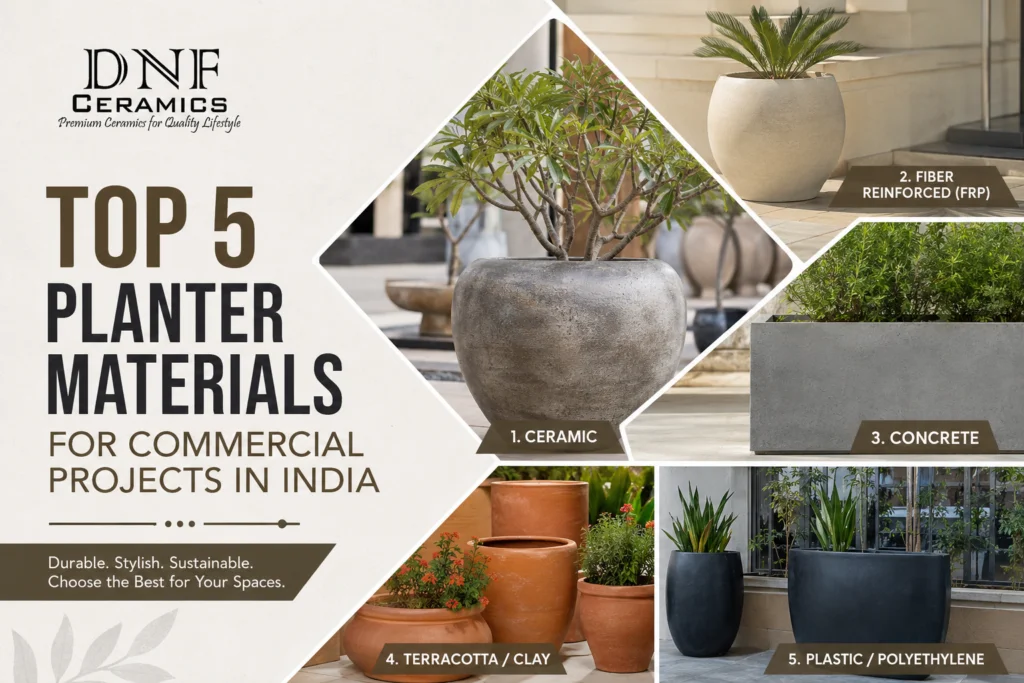
Material determines plant health performance, aesthetic register, weight, durability, and cost. The main options for commercial interiors: ceramic pots and planters for premium indoor environments; FRP planters for large-format or weight-constrained applications; terracotta pots for natural, rustic, or biophilic design briefs; ceramic vases for decorative accent pieces without live planting. For the material comparison, read FRP vs Ceramic Planters and Terracotta vs Ceramic Pots.
2. Height and Diameter
Specify both dimensions explicitly — not ‘large planter.’ For floor-standing planters in commercial spaces, a useful rule: the planter height should be roughly one-third to one-half the ceiling height for the piece to read as an architectural element rather than an accessory. In a 3.5m ceiling lobby, a 90–120cm planter is appropriate. In a 5m atrium, 120–150cm. Specify internal diameter separately from external diameter — the planting cavity size determines which plants can be accommodated.
3. Finish
Specify finish type (matte, satin, gloss, reactive glaze, unglazed natural) and colour reference (Pantone, NCS, or RAL if custom; standard colour name if from the manufacturer’s range). Matte and satin finishes are recommended for high-traffic commercial environments — they conceal handling marks and surface wear better than high-gloss.
4. Drainage
Specify whether drainage holes are required and their size. For live planted interiors, drainage is essential — without it, root rot develops rapidly. For display-only planters with artificial plants or decorative growing medium, sealed bases may be preferred. Read Do Ceramic Pots Need Drainage Holes for a full discussion of the options.
5. Base and Stability
For large floor planters on polished or sensitive floor finishes, specify felt pads, rubber feet, or a separate plinth. This protects the floor from moisture transfer and prevents scratching during positioning. Also specify whether the planter will be on a fixed plinth (in which case the planter and plinth dimensions must be coordinated) or on the floor directly.
6. Weight
For installations above ground floor — upper-floor lobbies, roof terraces, mezzanines — calculate the total weight: pot weight + growing medium weight + plant weight + water weight. Confirm this load is within the structural floor capacity. For weight-constrained situations, FRP planters or extra large FRP outdoor planters offer a significant weight reduction over ceramic.
7. Quantity and Variant Count
List exact quantities per variant. ‘Approximately 60 planters across the lobby’ is not a specification — ’62 pieces, 90cm cylindrical, ivory matte glaze, 40cm internal diameter, with 30mm drainage hole’ is. Precise quantities enable accurate quotation and correct batch planning from the manufacturer. See the MOQ guide to understand how quantities relate to batch economics.
When to Specify Custom vs Standard
Standard manufacturer ranges offer faster lead times and lower MOQs because production tooling already exists. Custom specifications — bespoke sizes, custom glaze colours, unique forms — offer complete design freedom but require longer lead times and higher MOQs. The decision point: if your project has a defined colour palette that the standard glaze range cannot match, a custom colour commission is worth the additional lead time. If the standard range offers a close match, use it. Read our guide to Custom Ceramic Pots — How to Place a Made-to-Order Request for the full process.
Coordinating Planters with the Planting Scheme
Planter specification and planting scheme design should be developed in parallel — not sequentially. The planter size determines which plants can be accommodated; the plant size and root system requirements determine the minimum planter internal diameter. A landscape designer or specialist horticulturalist should review the planter specification alongside the planting plan before the procurement order is placed. Common coordination failures: specifying a 30cm internal diameter for an areca palm that needs 50cm; specifying sealed-base planters for species that require drainage.
The Procurement Sequence
Once all seven parameters are defined across all zones of the project: submit the specification to your manufacturer as a formal RFQ. Review the quotation against budget. Request and approve physical samples for each variant. Confirm the bulk order with a purchase order referencing the approved sample. Plan delivery coordination with your site manager. For the full procurement guide, see How to Source Planters for Your Hotel or Resort in India. For direct manufacturer sourcing as a designer, see How Interior Designers Can Source Ceramics Direct from Khurja.