For Indian retailers building a ceramic pot category — whether you operate a home décor store, a garden centre, a gift shop, or an online platform — the sourcing decision you make determines your margin structure, your product differentiation, and your ability to restock quickly. Buying from a wholesaler gives you flexibility but compresses your margin. Buying direct from a manufacturer gives you better pricing, better product access, and a supply chain you control. This guide is for retailers who are ready to move from wholesale buying to direct manufacturer sourcing — and for those who want to understand exactly what that transition involves.
The Retail Ceramic Market in India: What’s Selling
The ceramic pot and planter category has grown substantially in India over the last decade, driven by the urban apartment boom, rising interest in indoor plants and biophilic interiors, and growing demand for handmade, artisanal products over mass-manufactured alternatives. The products with the strongest retail pull:
- Ceramic pots and planters — indoor planters in contemporary glazes (white, sage, terracotta-tone, charcoal) are the core retail volume category
- Ceramic vases — decorative vases for shelf and tabletop styling are a high-margin gifting category
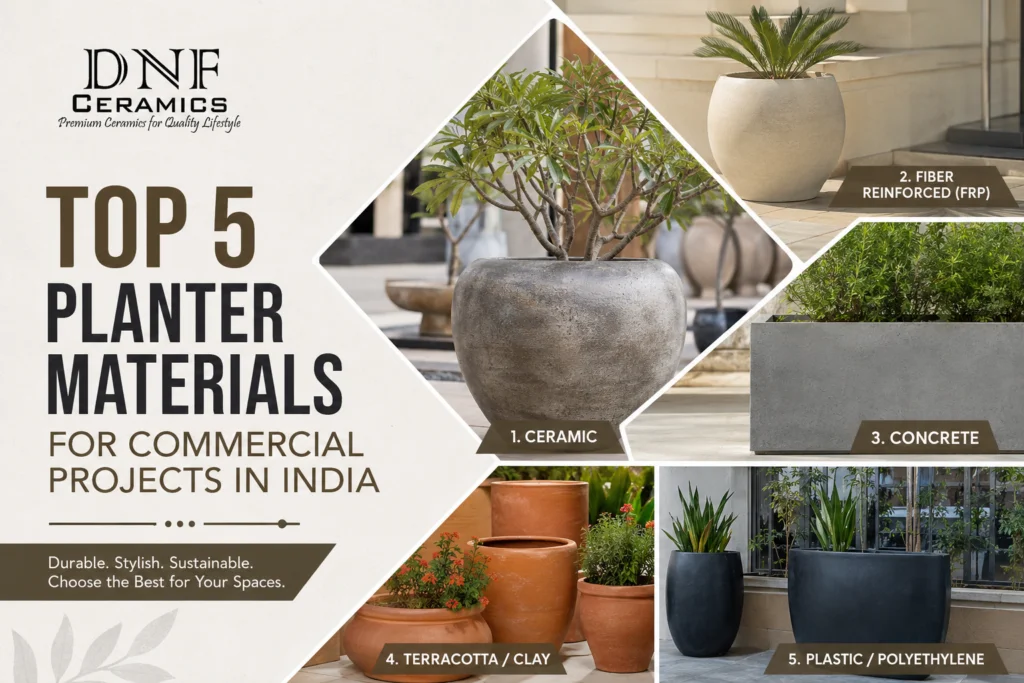
- Terracotta pots — natural terracotta has seen a strong revival in premium retail contexts, driven by the biophilic design trend. For the terracotta vs ceramic comparison, see our full guide
- Ceramic home décor — candle holders, aroma diffusers, table lamps, and decorative objects are growing categories in lifestyle retail
- FRP planters — lightweight large-format planters for garden and outdoor retail
Why Direct Manufacturer Sourcing Beats the Wholesale Route
The wholesale route is familiar and low friction — but it is structurally expensive for a retailer who is serious about margin. A Khurja-origin ceramic pot that leaves the factory at ₹300 per unit typically reaches a Delhi wholesaler at ₹420–450, and a Mumbai retailer at ₹600–700 — before the retailer’s own margin is added. Buying direct from a Khurja manufacturer like DNF Ceramics, a retailer accessing the same product at ₹300 ex-factory has 100–130% more margin to work with before reaching the same end price — or can undercut competitors while maintaining healthy margin. The case for direct sourcing is overwhelmingly economic.
Beyond price, direct sourcing gives access to: product exclusivity through custom glaze colours unavailable to wholesale buyers; larger size range including items that wholesalers don’t stock; faster turnaround on restocking; and a relationship where the manufacturer understands your seasonal and promotional requirements. For the full sourcing landscape comparison, see Where to Buy Ceramic Pots in Bulk in India.
Building a Product Range That Sells
The most common mistake retail buyers make when placing their first direct manufacturer order: trying to stock too many variants at insufficient depth per variant. A better approach is fewer variants at greater depth — which also makes meeting MOQ thresholds easier and reduces the complexity of your inventory management.
A proven starting range structure for a ceramic pot retail category: 2–3 sizes in a core glaze colour (e.g., warm white matte) that becomes your anchor line; 1–2 accent colours in the same size range; one statement variant in a reactive or special finish glaze. This gives customers the sense of a curated, coherent range rather than a miscellaneous assortment. For the MOQ thresholds that apply to each of these choices, see our MOQ guide.
Quality Checks: What to Look For
Before confirming any supplier relationship, assess quality across these dimensions:
- Glaze surface quality — run a hand across the glaze. A quality glaze is smooth, consistent, and free of pinholes, crawling, or bare patches
- Dimensional consistency — check three or four pieces of the same variant against each other. Handmade ceramics have slight natural variation; significant dimensional inconsistency indicates production control issues
- Structural integrity — check the base of each piece for cracks, particularly at the join between base and wall
- Drainage hole quality — holes should be clean-edged and consistent in placement
- Glaze colour consistency — compare across pieces in the same batch. Acceptable variation: subtle tonal shift in reactive glazes. Unacceptable: significant colour departure between pieces
Always request and inspect physical samples before bulk confirmation. Do not rely on photographs for quality assessment.
Seasonal Planning and Restock Strategy
Ceramic retail has clear seasonal patterns in India: Diwali (October/November) is the peak gifting and home décor season — stock should be in-store by September; summer (March–May) drives outdoor and garden planter demand; the post-monsoon period (September/October) sees renewed indoor plant and pot interest. Plan your manufacturing orders 45–60 days before the start of each season peak to account for production and logistics lead time.
For restock strategy: identify your top 3–5 selling variants from the first season and double the opening order for season two. Build your restock timing around manufacturer lead times — read Lead Times for Bulk Ceramic Orders to plan accurately.
Exploring Private Label and Custom Options
As your volume grows, explore private label options — your store name or brand applied to your ceramic range. DNF Ceramics offers custom ceramic pots including logo printing, custom glaze colours exclusive to your brand, and bespoke sizes. This is the step that moves a retailer from a distributor of commodity ceramics to a brand with proprietary products that competitors cannot simply replicate. For top manufacturers in India and their export credentials, see our dedicated guide.